Sunday, February 13, 2011

Roman Ruins in Morocco: Volubilis

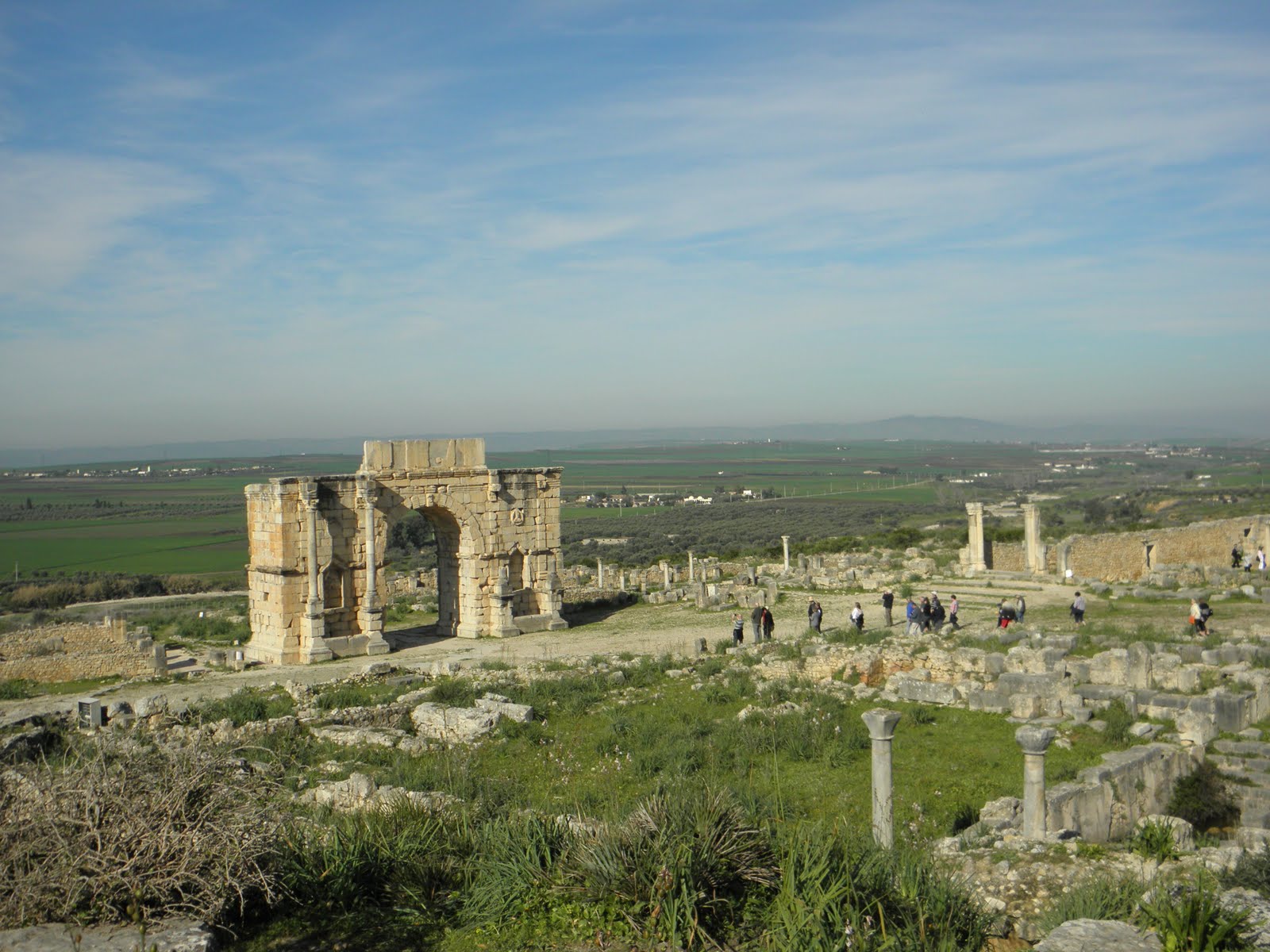
This was a crazy weekend. Yesterday, we went to Volubilis, an ancient roman city, and to Moulay Idriss, the first Islamic city of Morocco. Today we hiked for about 4 hours to the top of a mountain in the Middle Atlas Mountain Range near the vilalges of Ifrane and Azrou. All of this was really sweet, but for right now, I am going to focus on Volubilis.

Who knew there were Roman ruins in Morocco? I certainly did not. Volubilis, dating from around the 3rd century, was built to organize the grain production in Morocco and to control the Berber tribes. The idea was that the people in Morocco would grow all this grain, feed the Roman people in Volubilis, and send the rest back to Rome, all without complaining or getting paid. Imperialism much? Well turns out it didn't work out quite so well, the Romans were never able to fully conquer the Berber populations.

Despite that small setback, Volubilis was a thriving city for a very long time. (think longer than the US has been around, way longer). It was inhabited for atleast 1,000 years, but not entirely by Romans. The Romans had mostly evacuated Morocco by the 6th century, but a group of Volubilis citizens stayed behind and mingled with the tribal people.

This is what is left of the courthouse. 
Through out its long history, parts of the city have been taken down in order to recycle building materials and earthquakes have torn down bits and pieces as well. The most disastrous earthquake was the 1755 Lisbon Earthquake that took down a significant portion of the city. The structures that are left are pieces of community buildings, foundations for wealthy persons homes, and the main street. 

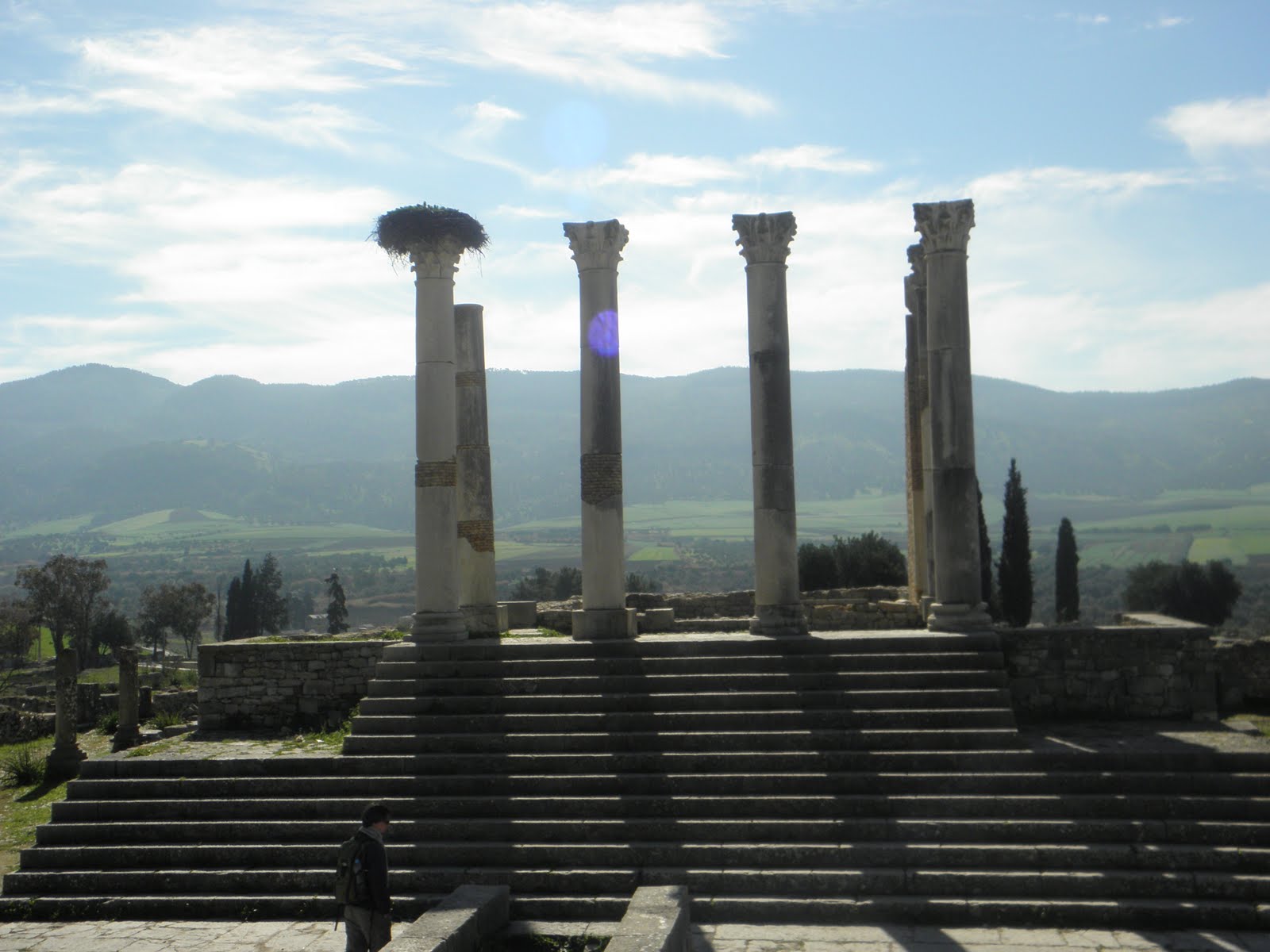
What's left of the temple. Volubilis was built way before the Romans became Christians so this temple was for a god or goddess. Animal sacrifices would have taken place just at the top of the stairs.
The homes are identified by the mosaic floors that are still intact even though the walls are long gone. The houses are built in the typical Roman fashion; one big square with a courtyard in the middle and a hall way surrounding. This architecture would later become a signature style of Morocco in the Riad style buildings.
Close up of a floor mosaic. This mosaic depicts the goddes Diana getting out of her bathtub and being watched by a peeping Tom. She catches him and turns him into a stag and he is then hunted down by his own hunting dogs. Sad day.
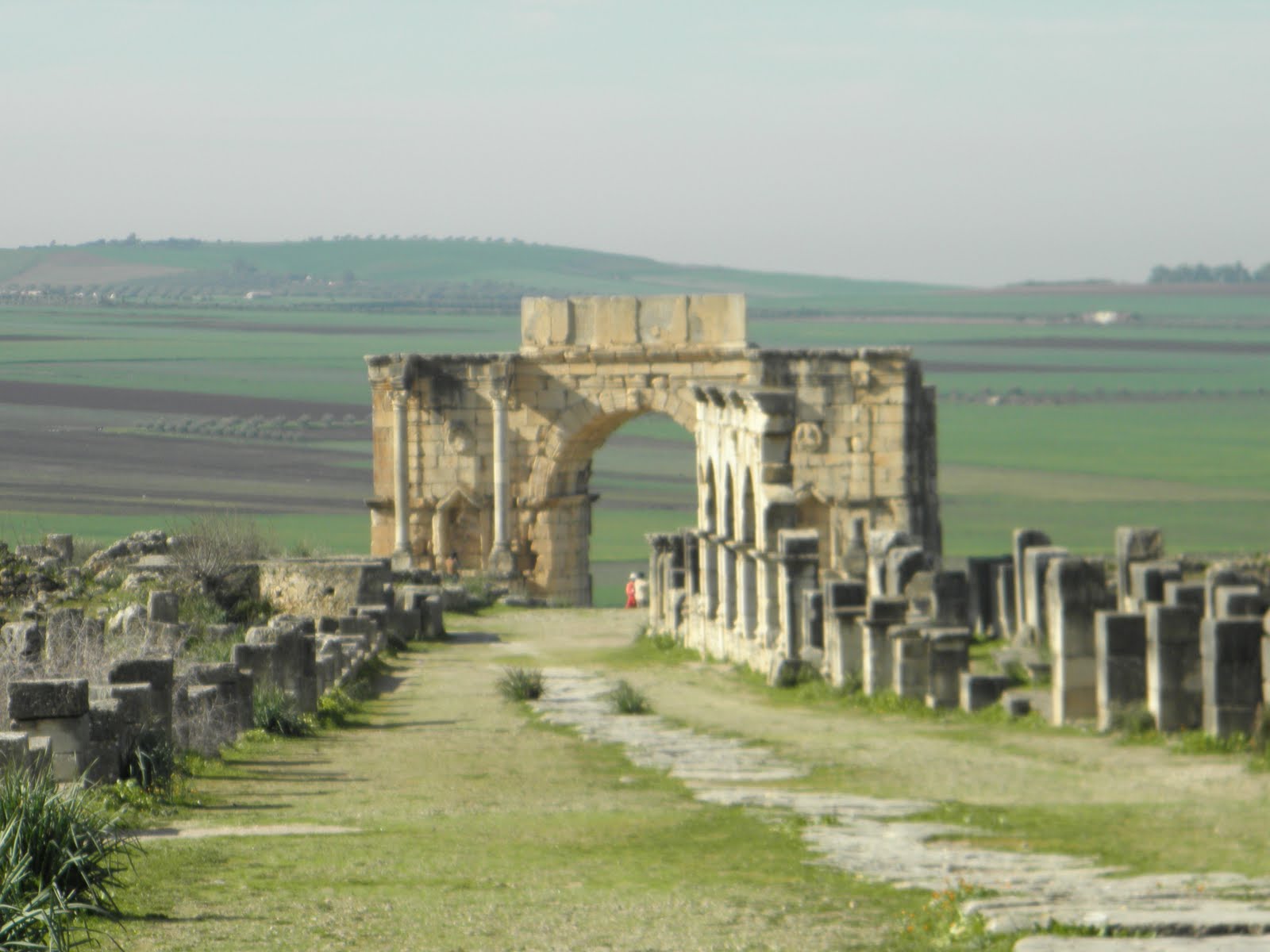
The main street of Volubilis is very much still intact and you can almost imagine how grand it used to be. There is a center path of stone, which in fact is covering up the sewer system, quite a modern technology for the Romans. Each side was lined with columns and arches and also had side walks. All this led right up to the triumphant arch which was the formal entrance to the city.


Thursday, February 10, 2011

The Epiphany of Taa Marbuta

So this post may not be interesting to everyone, but i really got excited about it today so I'm going to share. This is going to be an odd lesson of Arabic, nothing you'll really be able to use haha just kind of some fun information. It blew my mind in class today.

  Ok so here are some basics. The third letter in the Arabic alphabet is taa. It sounds similar to the english T except instead of the eee sound after the t its an aah sound. taaaa. It looks like this:

Kind of like a smiley face. You start from the right and do the big curve and then you go back and add the two dots.
There is another letter in Arabic that sometimes sounds like taa and sometimes sounds like Alif, the letter A, which sounds like aaahh. This letter is called taa marbuta. It lookes like this:

You start from the right again and cross to the left, then go under to the right, and back up to the left. At the end you add the two dots. This sign is often, but not always, used to determine femininity of a word or a name. 
Now until today, I just thought they were two separate letters, that just sounded the same sometimes. That was until my professor, Dr. A. Zakaryae, completely changed my world.

This is where it might get a little complicated for those of you who do not know Arabic, but just keep reading and I hope you'll understand at the end.  

All Arabic words are derived from a root word, which is usually made up of three letters, sometimes four but not often. For example the letters Kaa taa and Baa, put together make kataba which means to write. Make it maktba and you have library. Kitab is book and Mktab is office. All interrelated words that have the same root. 

The root for marbuta (aka taa marbuta) is rraa baa taa. It looks like this:

Rraa is the curved slash mark on the far right. The hash above it is a fatha and it symbolizes the short vowel ah. The curve with one dot underneath this baa and the last letter is taa which you saw above. 
Rabata in this form means to tie. Now lets see it in the word marbuta:

Mim or the mmm sound is the first letter on the right. The we have rraa and baa in the highlighted square because they are part of the root. After that we have wow which is the uuuu sound. Then Taa which makes a deeper sound, almost like the letter D in english and then the taa marbuta which represents the taa from the root letters. 
taa marbuta is the word that describes the symbol. Marbuta with the root to tie means tied up. So taa marbuta is literally a tied up taa. Which totally makes sense when you look at the symbols! The bottom curve of the taa gets twisted up and knotted at the top and thats why there are two ends that stick out. When its tied up it sounds like ahhh, but it some circumstances it gets untied and sounds like taa. This just completely made my day. I know that not everyone finds this fascinating, but I really enjoy it. You know in kindergarten when you have the videos of the alphabet and the letters walk around and act kind of like people? Like Miss A eats an apple and the letter A suddenly has a mouth and teeth and is eating an apple. Well I just picture taa walking around and tripping on a stone or something and getting all tied up and becoming taa marbuta.


P.S. When I opened the page, I had trouble loading the pictures. I don't know how to fix that, but if you just click the spot where the picture is, it will open up the picture in a new window and it will be bigger as well. 


Monday, February 7, 2011

The Hand of Fatima

Alaina's keychain

The Hand of Fatima, The Hand of Miriam, the Hamsa or the Hamesh. These are all names for the same symbol. This symbol is found on jewelry, wall decorations, and art. The main symbolism is to ward of the evil eye and to provide a protecting hand. There are a few different styles and the symbol is used in both Islamic and Jewish cultures, although it most likely predates both religions.

The Hand of Fatima refers to Fatima, the daughter of Muhammed. This is the name most often used in Islamic cultures. Hamsa means the number 5 in arabic, meaning the 5 fingures on the hand and symbolizing the 5 pillars of Islam. The Hand of Miriam is used in Judaism. Miriam was the sister of Moses and Aaron. Hamesh is 5 in hebrew and is used to symbolize the 5 books of the Torah.

Archeology has suggested that the symbol predates both religions and was originally the symbol of a goddess of an ancient religion. This could explain why both use this symbol, but neither religion officially recognizes it.

The symbol can be depicted as a biologically natural hand as shown above, or with two thumbs, one on each side forming a symmetrical hand. Sometimes an eye is placed in the middle of the palm, reinforcing the idea of protection from the evil eye.

This necklace belongs to Tova, a year long study abroad student here in Morocco. It displays the symmetrical two thumbs version with the eye in the middle.

When we got here, I noticed that lots of people had this symbol. It was on necklaces, key chains, bracelets, and in henna patterns. I find it to be a very beautiful symbol, especially because it unifies the two religions that used to be very close, but because of relatively recent political situations have had a lot of conflict. Many peace activists in the Middle East have adopted the symbol for that reason.

This is my new Hand of Fatima bracelet. My roommates each got one as well but in different colors.

Thursday, February 3, 2011

El Alhambra: The Walled City of Granada


We are now in Meknes, Morocco! Tiffany and I have unpacked already, pictures have been posted here and we are settling in. But i need to back track a bit because I left a very important piece of Granada to still be discussed.

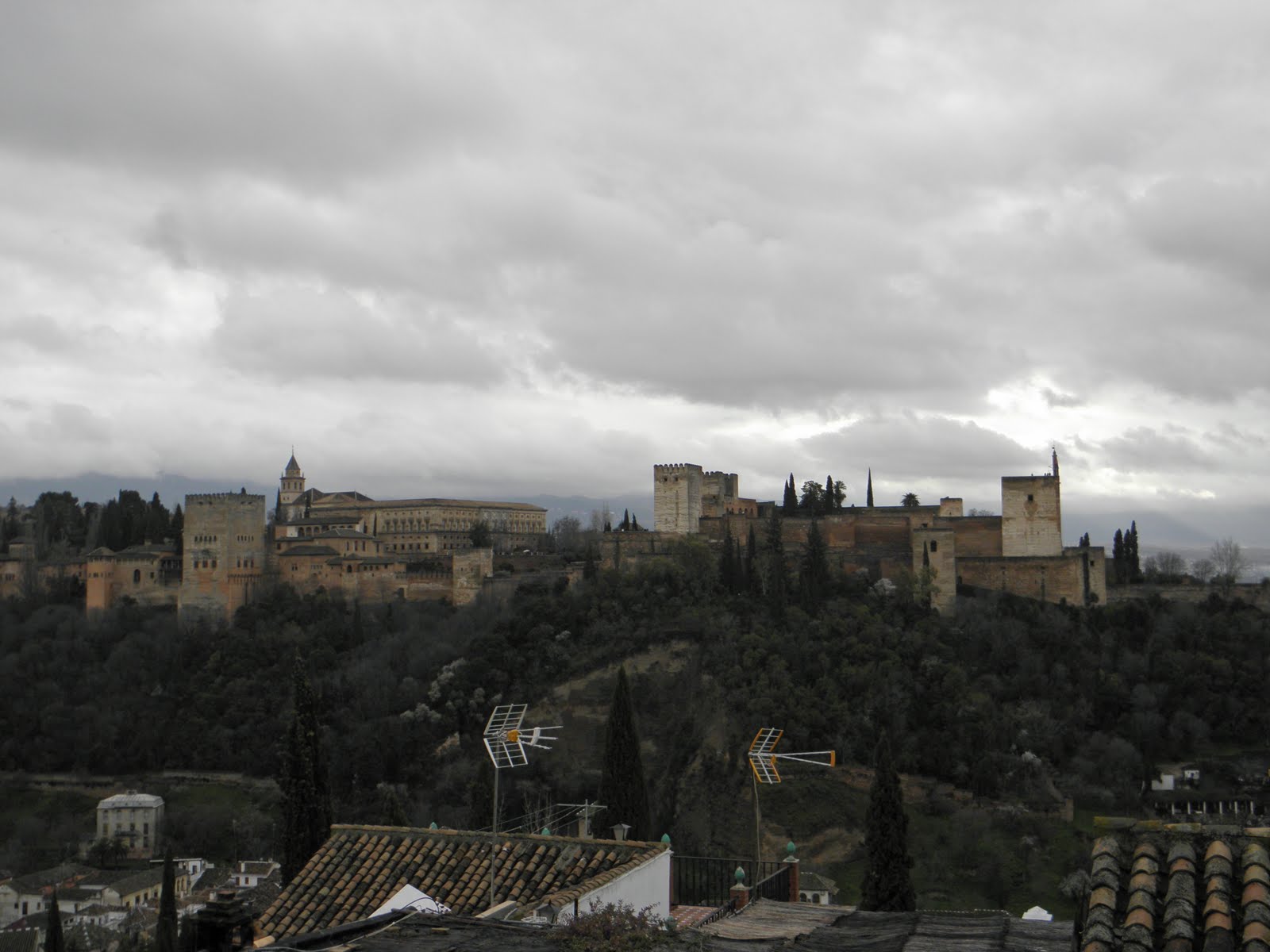
The Alhambra. For those of you who know Arabic, you might be confused because al means the so i am in fact saying the the alhambra. Well Europeans do this quite frequently because when they start naming things they usually have not yet learned the language (Rio Grande River). Hambra means red castle, most likely referring to the color of the materials used to build it. I am using a book called Granada and the Alhambra to fill in the info that I don't remember from the tour, but all the pictures are mine.

The Alhambra was built by the Nasrids. They were the last reigning Muslim dynasty in Spain and they ruled from 1238 to 1492. Muhammad Ibn Yusuf Ibn Nasr Ibn al-Ahmar( or Alhamar the Magnificent for short) ruled over Granada, Malaga, Almeria, part of Jaen, Cordoba, Seville, and Cadiz. He succeeded where the others failed because he decided it would be a good idea to become a vassel of King Ferdinand III of Castile. This meant that he no longer had to worry about attacks from the Spanish people and could better focus his attentions on the defense from the Arabs. Alhamar began the building of the Alhambra as soon as he took power. It is located up atop Sabika hill and Alhamar had a weir constructed to deliver water to the top. He also had the walls built and a military fortress was built on top of an ancient, most likely roman one. The fortress(the Alcazaba) is triangular in shape because this makes it easier to defend than a square or a circle. It was also used as the king's living quarters(Alcazaba means palace) until a better palace could be built. The Alhambra was never breached, even during the surrender of the city to the Christians in 1492. There is a long line of kings until Boabdil, the last Nasrid king, handed the city over to Isabella of Castille and Ferdinand of Aragon in 1492 so instead of going through king by king, I'm just going to tell you about the important features.

If you haven't noticed by now, Islamic architecture is very plain and unadorned on the outside, but brilliantly decorated and beautiful on the outside. This is in stark contrast to the European buildings which are very intricate on the outside but are rather plain on the inside. This is explained by a pretty general Muslim philosophy of living your life looking inward. Inward to your soul, inward to your family, and inward to your home. Everything you do in life is supposed to be for God, for you, and for your family not for the world. The Alhambra provides excellent examples of the major styles of Islamic architecture at its finest. Being a palace for kings, everything from floor to ceiling is amazingly complex and beautiful.

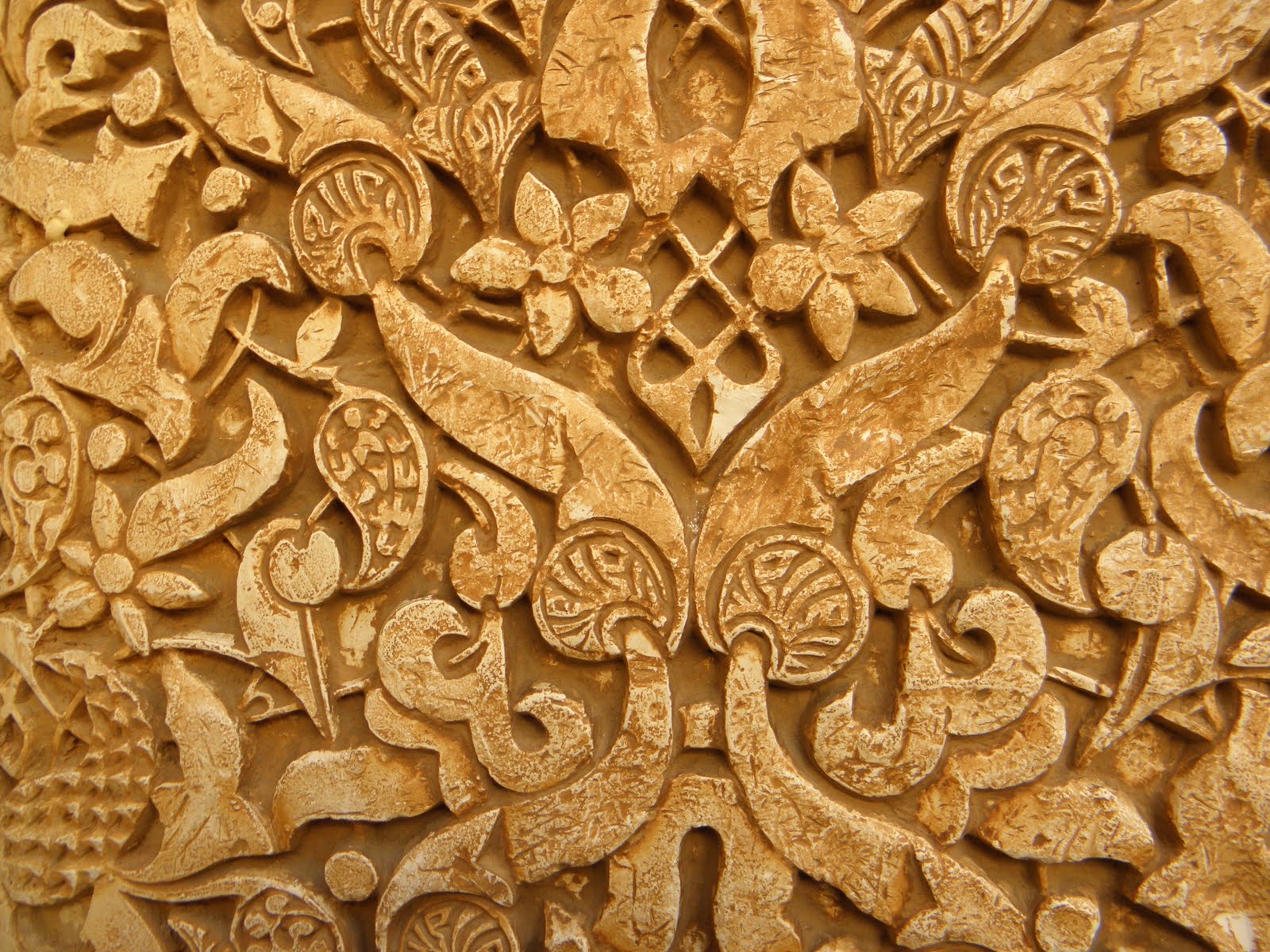
Stucco is the most widespread method used to decorate in Islamic architecture. It is mixed, molded or carved, and then finished to give it a shine and durability. Then it would be painted with bright colors or gold leaf.

Example of detailed stucco molding. This would have been painted. This pattern frames the king's entrance in the Mexuar coutryard.


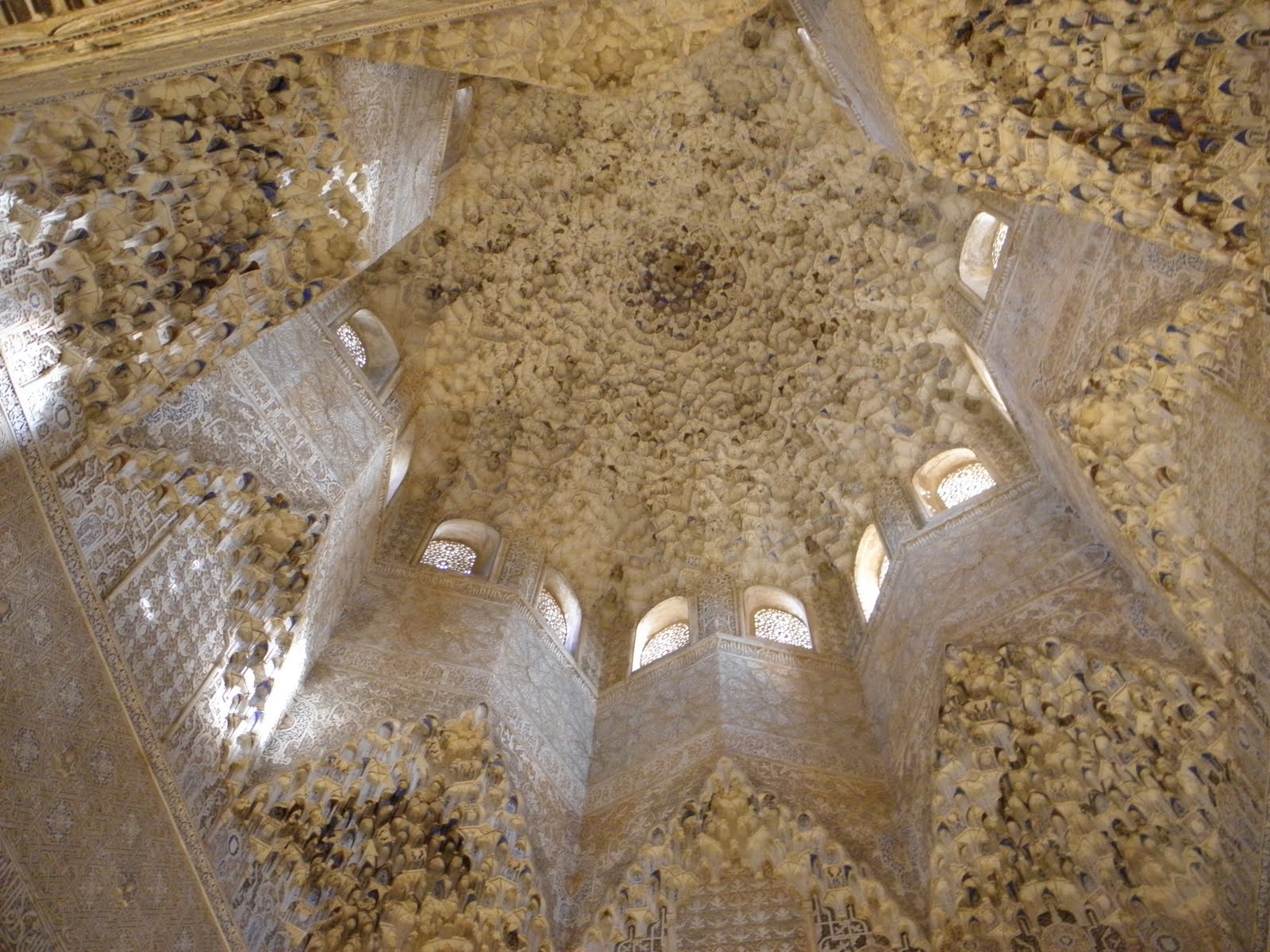
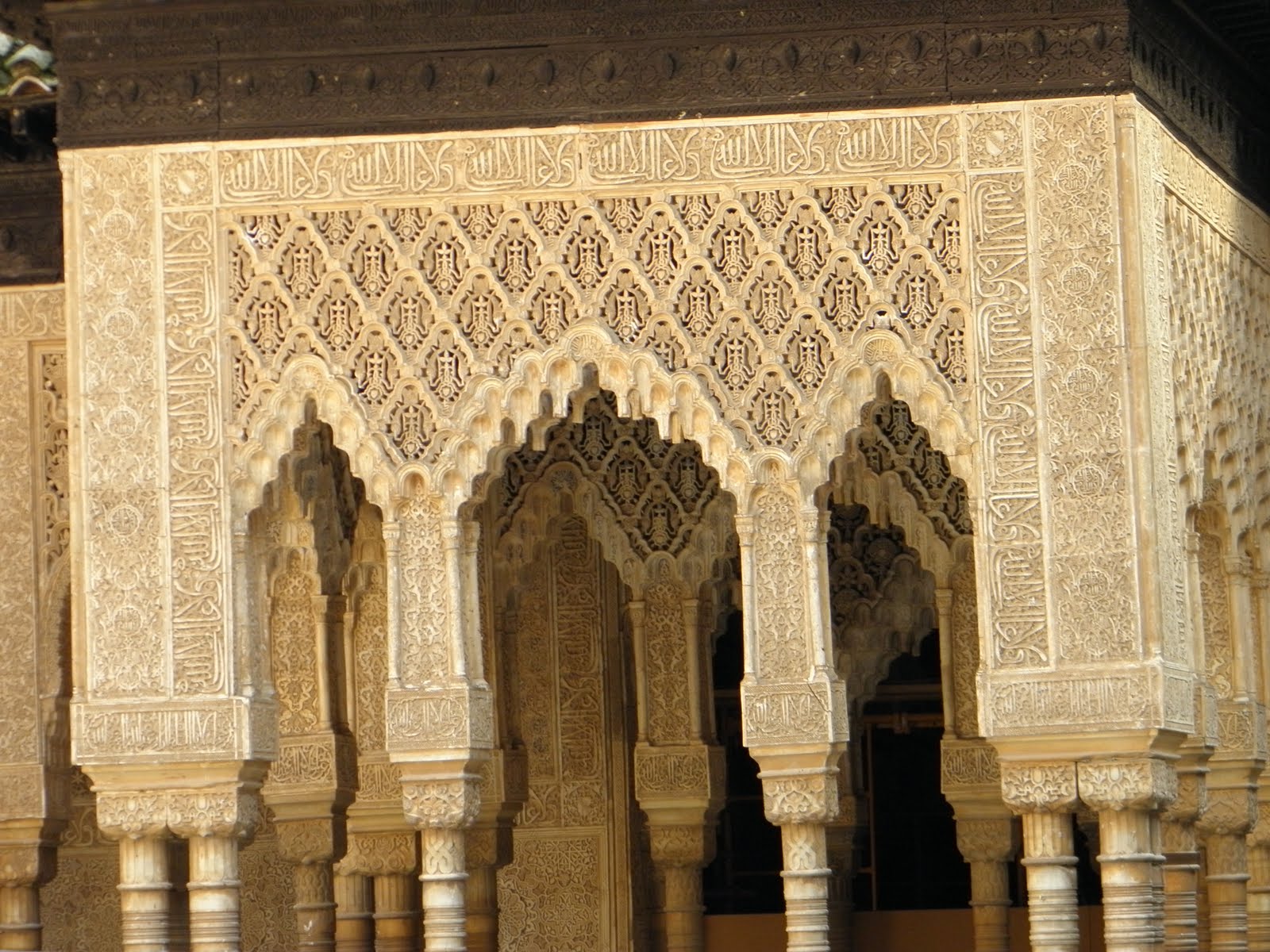
Muqarna are prisms shaped out of wood or stucco. They are used to decorate everything from arches to ceilings. Many of the ceilings in the palaces are covered with Muqarna. The vaulted ceilings form a large 8 pointed star and the Muqarna come down to represent stalactites in all sorts of geometric patterns. The idea of having stalactites comes from the story about Mohammad sheltering himself in a cave on his flight from Mecca to Medina. 


Cieling of the Cupola of the Hall of the Abencerrajes covered in Muqamas.
Entrance to the Courtyard of the Lions. The arches are adorned with Muqamas.
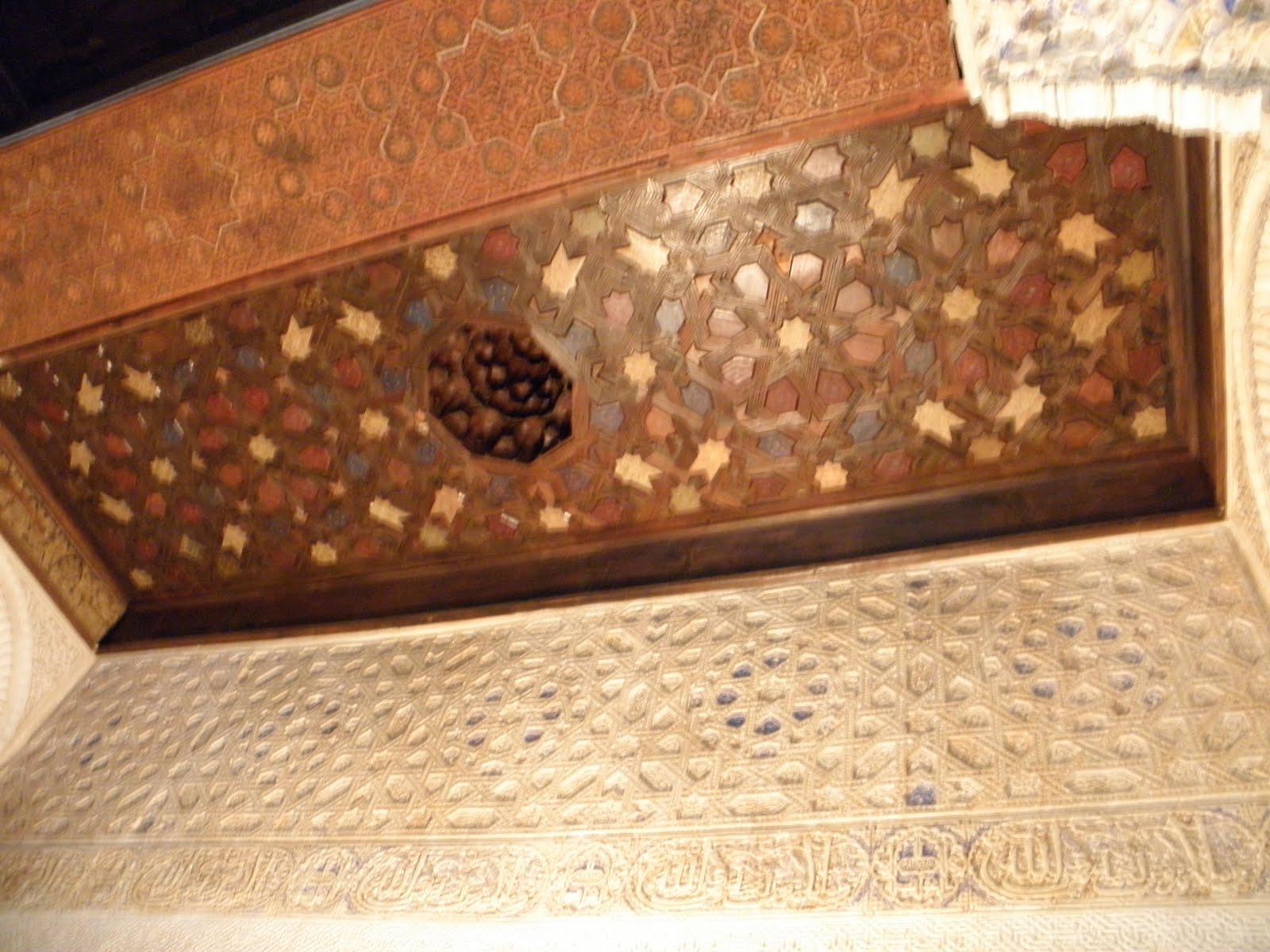
Decorative wood ceilings were made of cedar. They were either intricately carved and painted or inlaid with other types of wood to create geometric patterns.

Inlaid and carved wood ceiling. I don't remember which section of the Alhambra this was.
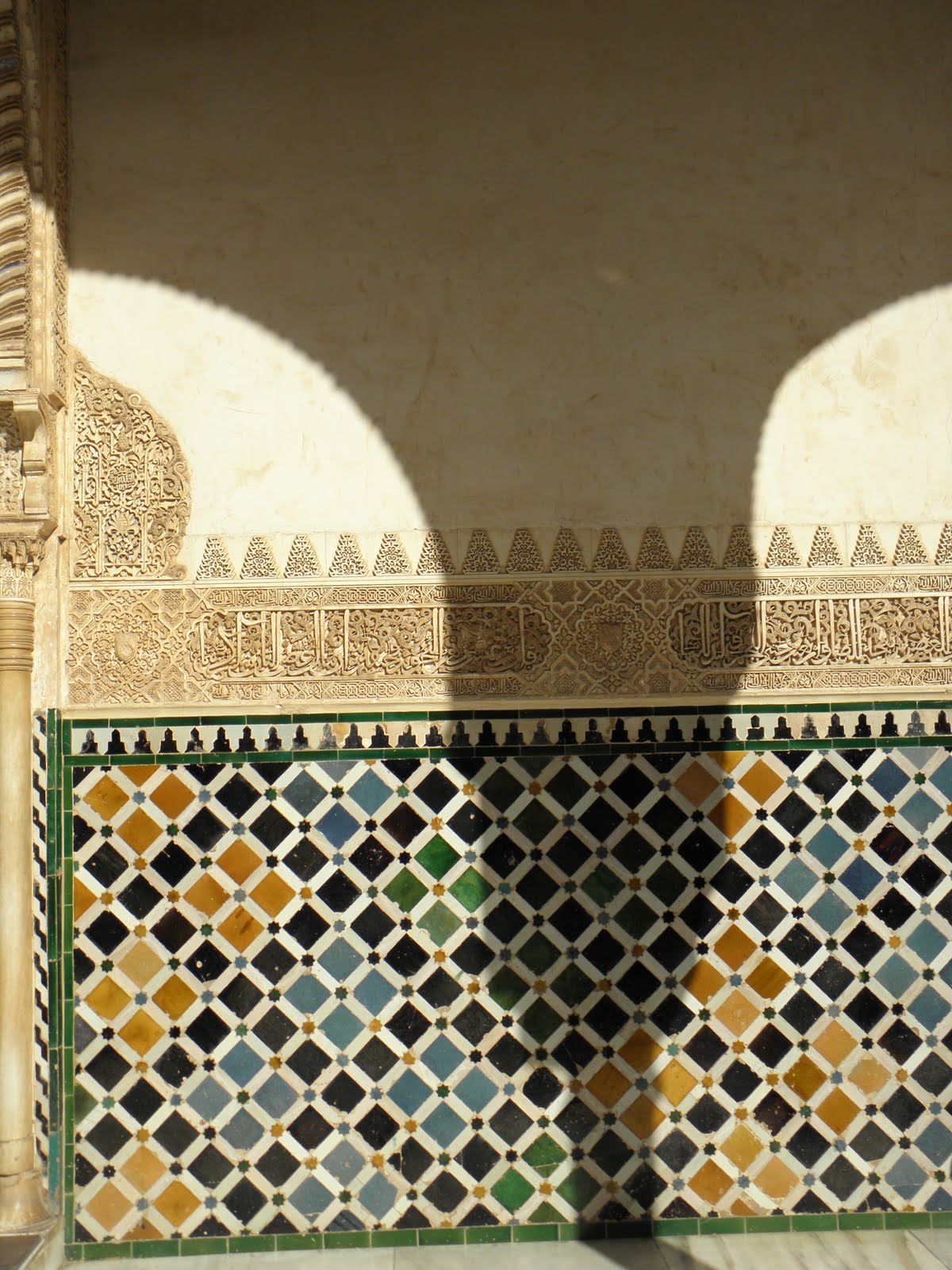
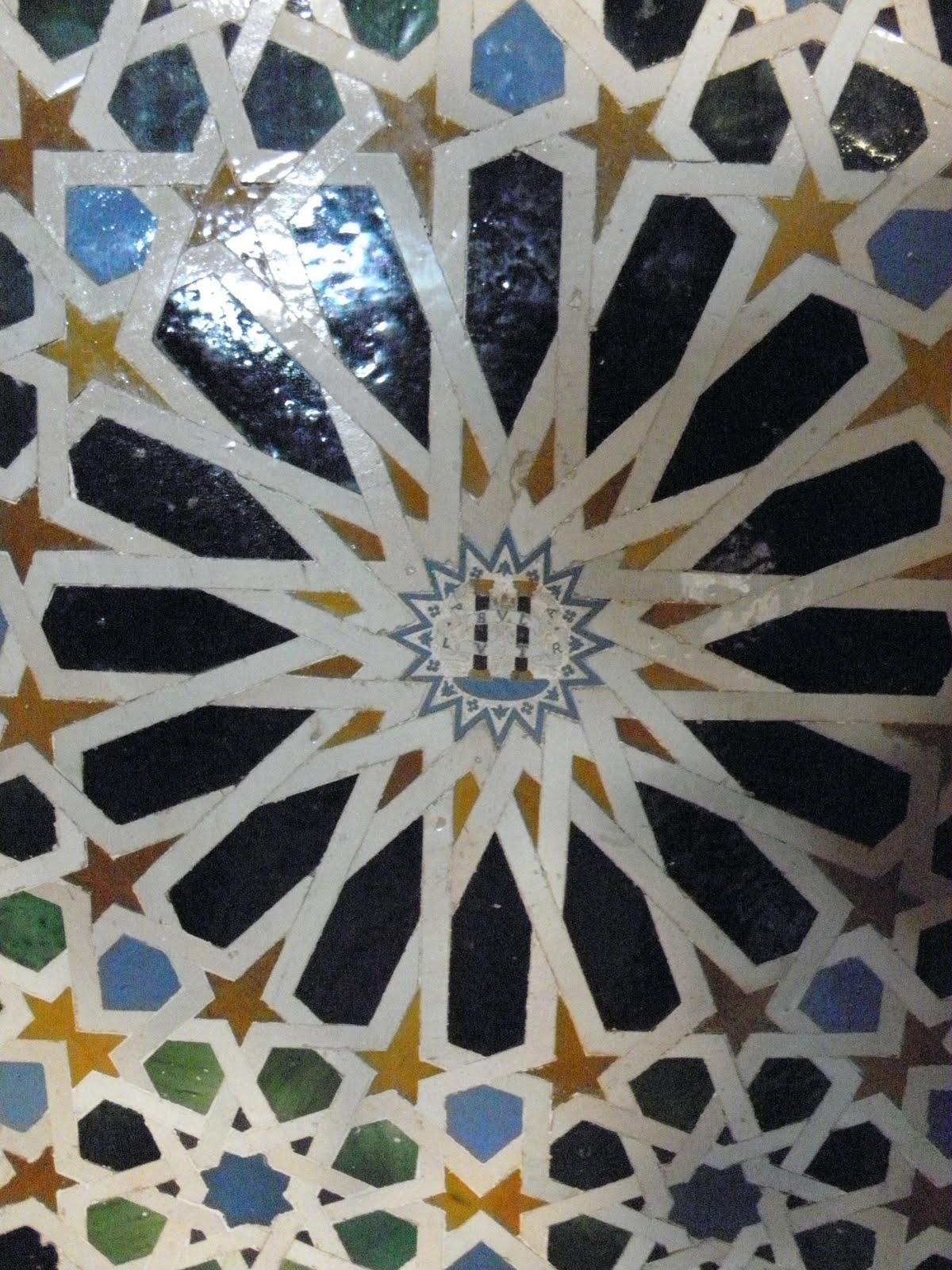
Azulejos and Alictados (Tiles and Ceramics) are very detailed and required a time consuming process to get them just right. They decorate every ince of every floor and the bottom half of every wall in the Alhambra. Decorative tiles began being used and developed in the 11th century and the skill progressed greatly in North Africa and Spain. 


Wall surround in the Patio of the Mytles (Patio de los Arrayanes)
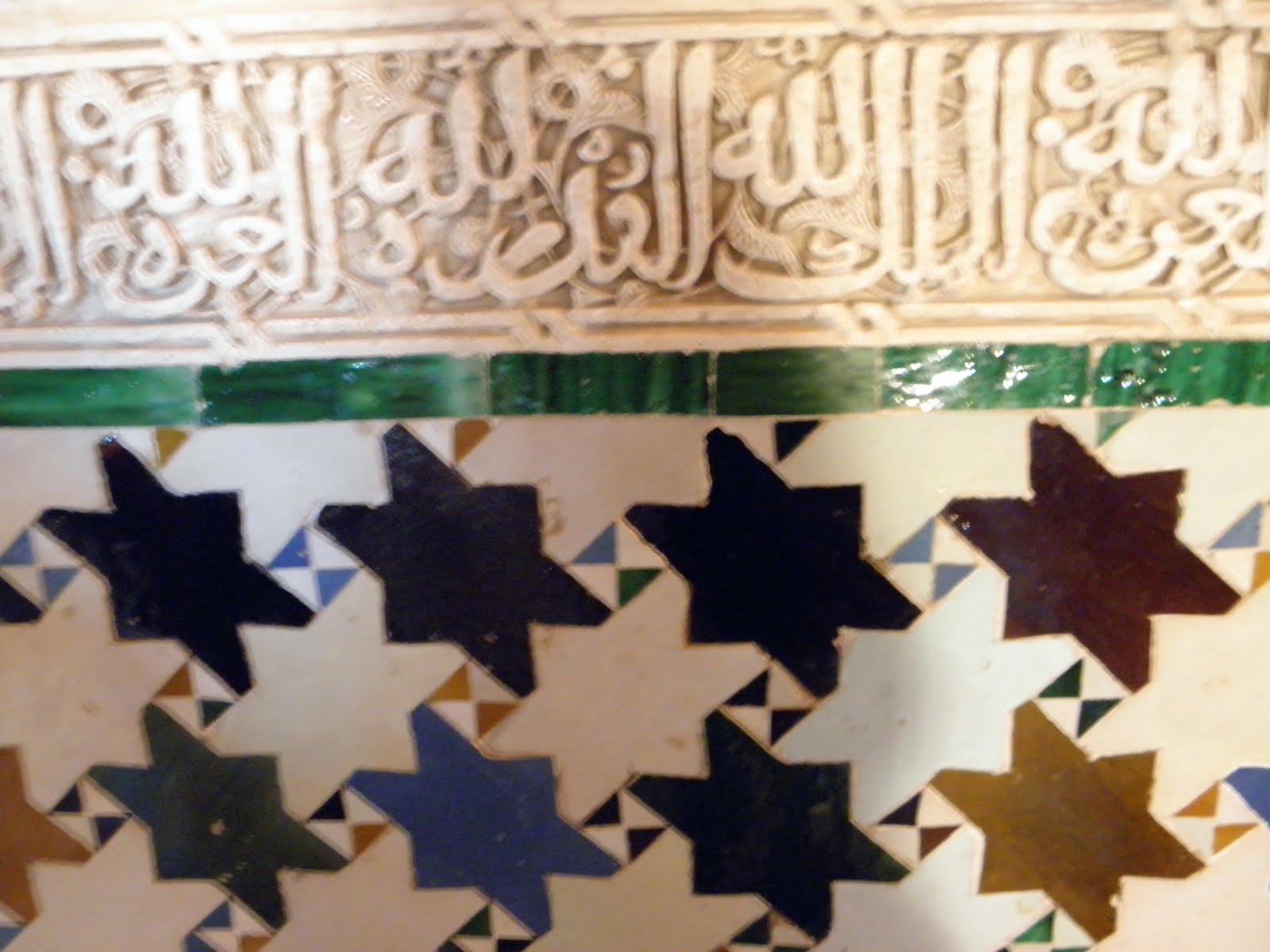
Calligraphy is widely used in Islamic architecture. Often a blessing from God or a poem written as though the building itself was speaking are written around the door frames and walls. 

The calligraphy often divides a tiled section of wall from a stuccoed section. 
This is such a long post already and I've only described the basic architectural elements of Islamic design. I think the specifics of the Alhambra will have to wait until another time. Check back soon!


Sunday, January 30, 2011

The City of Pomegranates


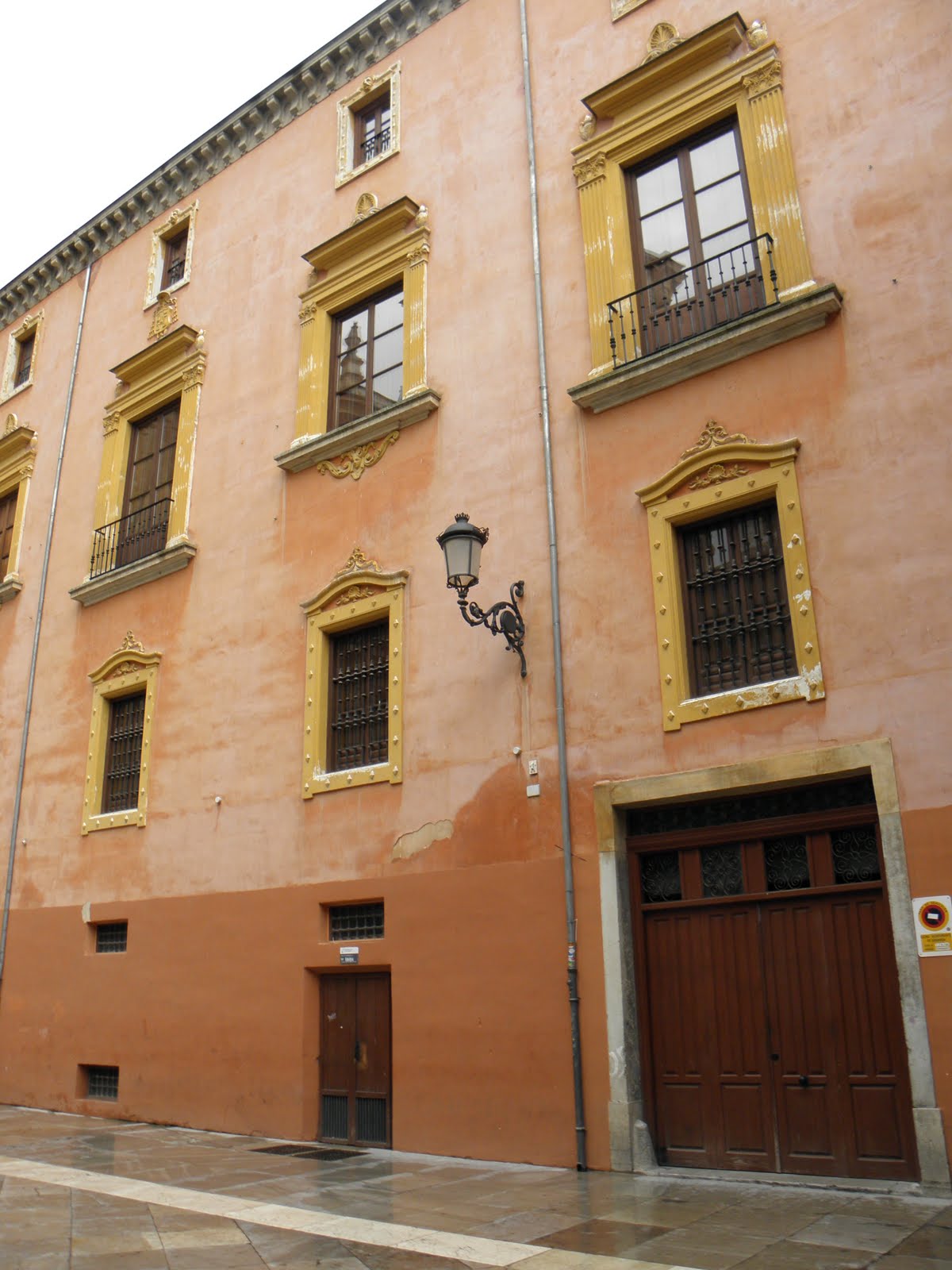
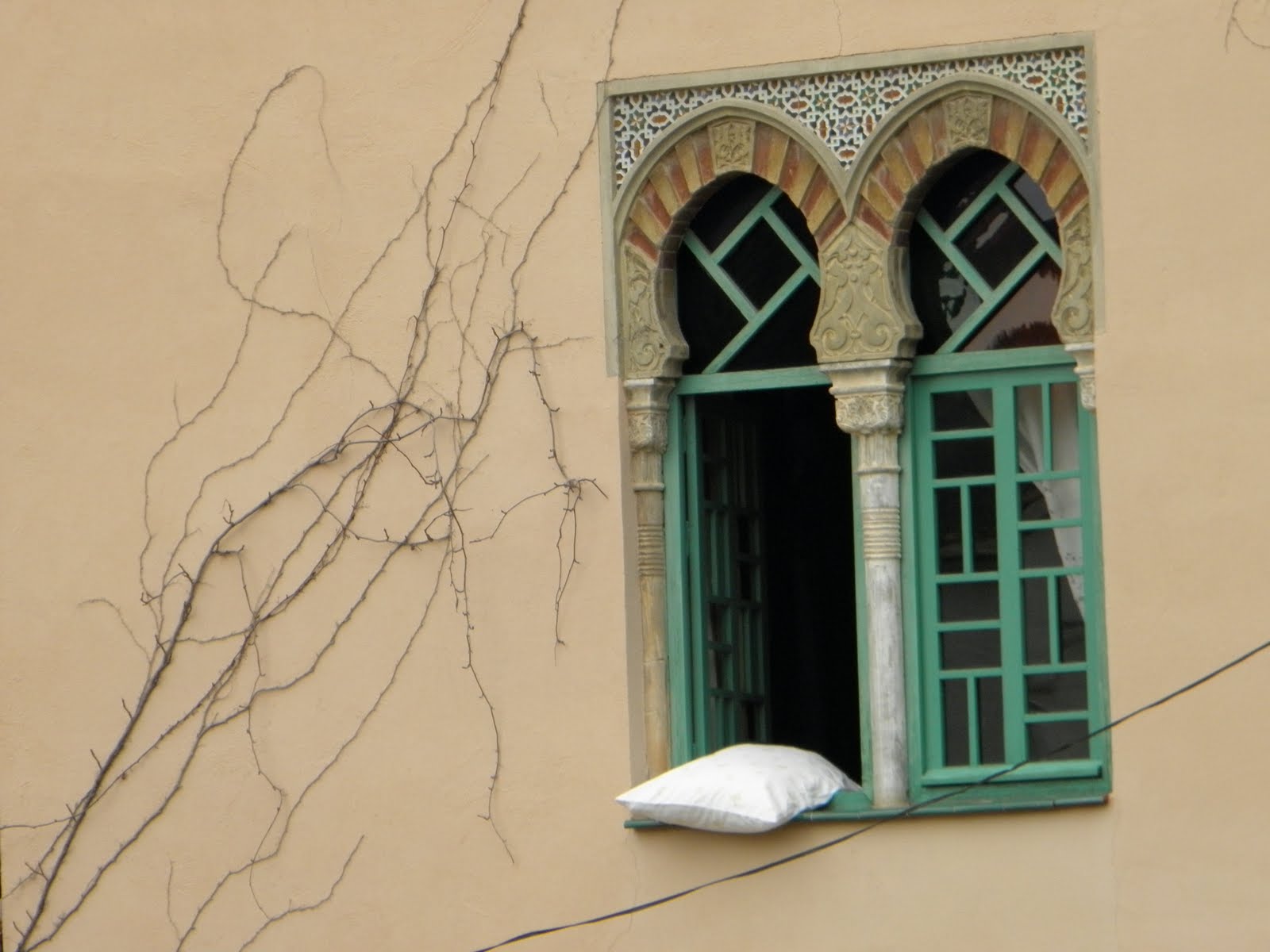
Granada is a beautiful city in southern Spain. It has an amazing mix of cultures which gives it very cool architectural and design elements. There are lots of arabic elements found in the architecture; big arches, arabic script, mosaic tiles. These all blend together with the European facades and Spanish style roofs. 
I love the details around the windows and on the lamp in the picture to the left. Same with the picture above. The tiling around the arches and the pattern in the window pane is very interesting. 


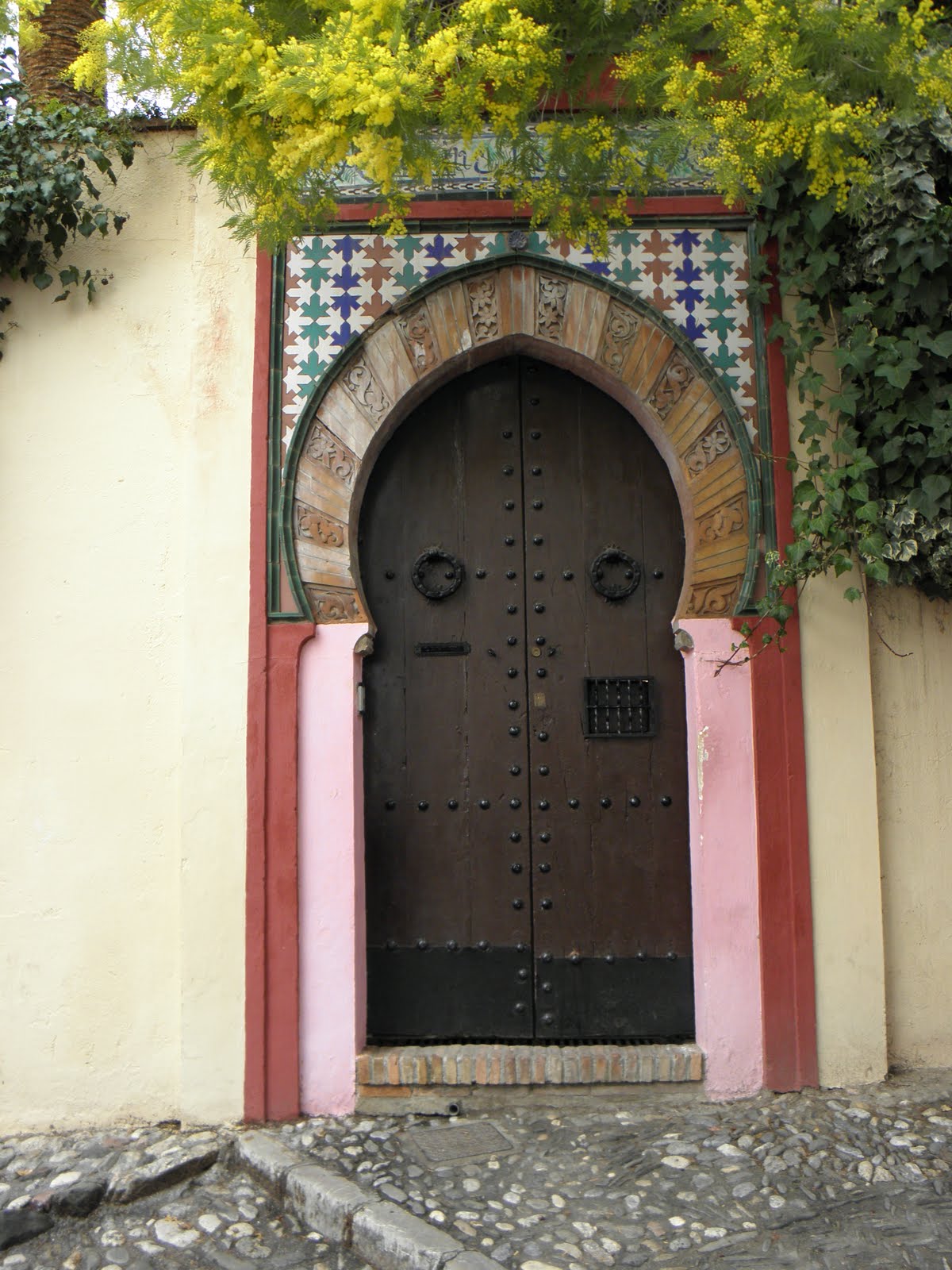
I wish the front door of my house looked like this.
"In 1238, Ibn al-Ahmar rose up against Ibn Hud and conquered parts of the province of Granada. He established the kingdom of Granada, which extended from the mountains of Sierra Nevada to Gibraltar and which was originally made up of the province of Granada (where he set up his court), the provinces of Malaga and Almeria, and part of the provinces of Cordoba, Jaen, Sevilla, and Cadiz." http://granadamap.com/history.htm

Granada was ruled by the Moors (Berber and Arabic peoples from North Africa. They believed in Islam and conquered much of the Iberian peninsula, the term Moor was used by Europeans to describe the people, not one they used to describe themselves) beginning in the early 700s during the Ummayyid dynasty which was an important portion of Islamic history. The Moors had control of Granada until Ferdinand and Isabella took over in 1492, the same year that Isabella approved Christopher Columbus' adventure in the Americas. This was the height of Spanish power. Isabella and Ferdinand united all of Spain and moved to Granada. 

In order to conquer an area, the rulers had to convince the people that a new way of life was better than the old. They outlawed the old religions, in this case Islam and Judaism, and forced people to convert. The tore down old religious buildings and built new ones. Many of the churches in Granada were originally Mosques. 

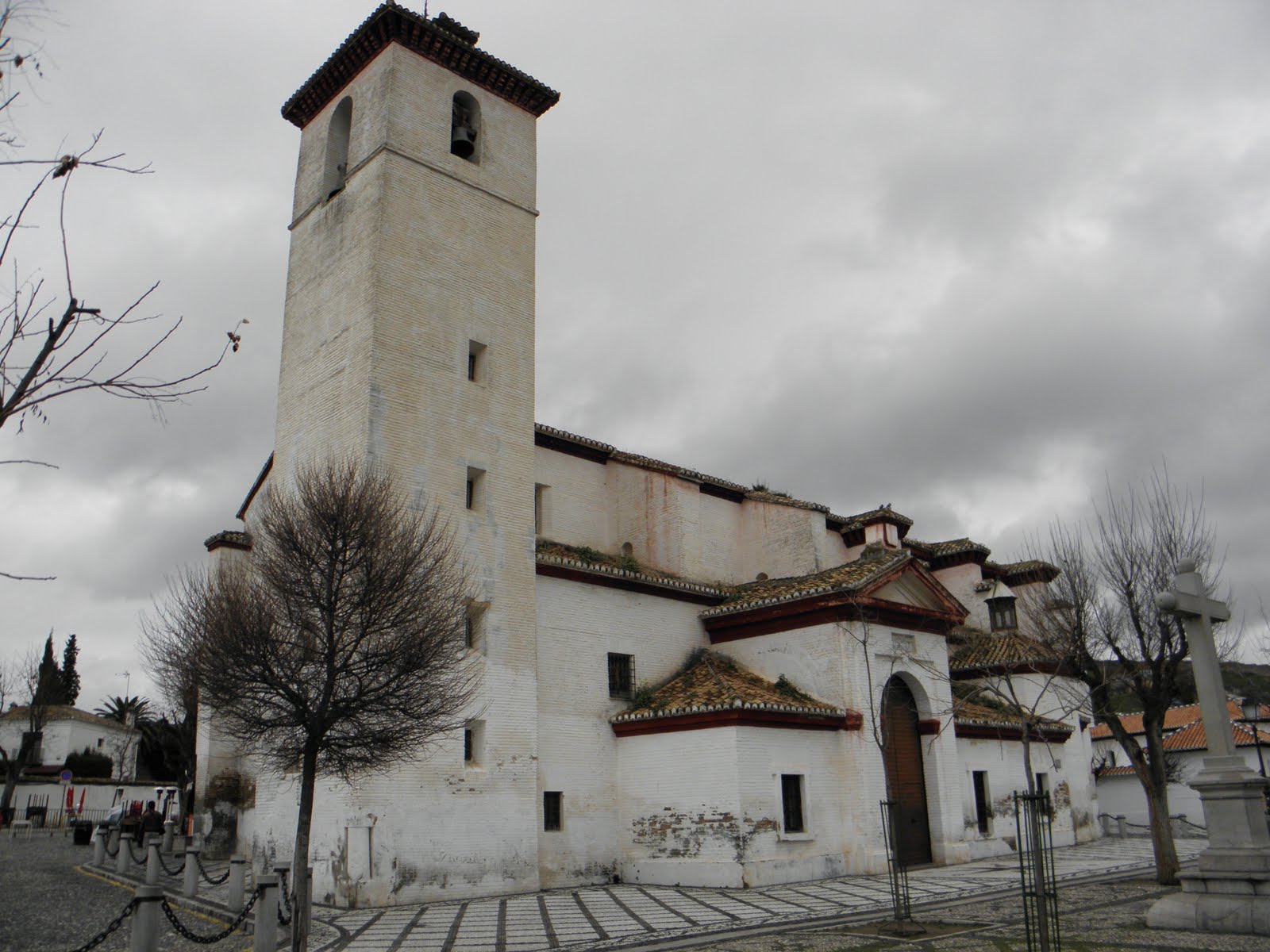
This church in the Placeta de San Nicholaus was originally a Mosque. Converting these building was fairly easy. The minarets were used to give the call to prayer 5 times a day for Muslims. Since they were tall and already had good acoustics they were easily transformed into bell towers for Catholic churches.

There is currently only one Mosque in Granada and it has been built just recently. Change is very slow and it has only been about 500 years since the conquest. In United States history, 500 years is a very long time, but in Europe and the Middle East it is barely any time at all. 

When Isabella and Ferdinand took over, they tore down one of the main mosques and built a massive cathedral. Everything is personalized for the king and queen. Their initials can be seen on the pews and the columns and on adornmants outside the cathedral. The Cathedral has a very different design than most Catholic cathedrals. The building is shaped like a cross. The top of the cross, or the head, is a large circular shaped area that contains the alter on the inside. A large pathway goes around and is separated from the alter by a series of arches.  The center line of the cross makes up the congregational area. This was very innovative for its time because usually there was a separation for the nobles and the lower classes. There would be a wall dividing them so the lower classes were unable to see the alter. This cathedral has no separation so all were able to see. Along the sides are a series of small chapel areas that noble families could buy. They then filled them with expensive and ornate religious objects for all to see. They were able to bury their dead in these chapels and mostly show off their wealth. 


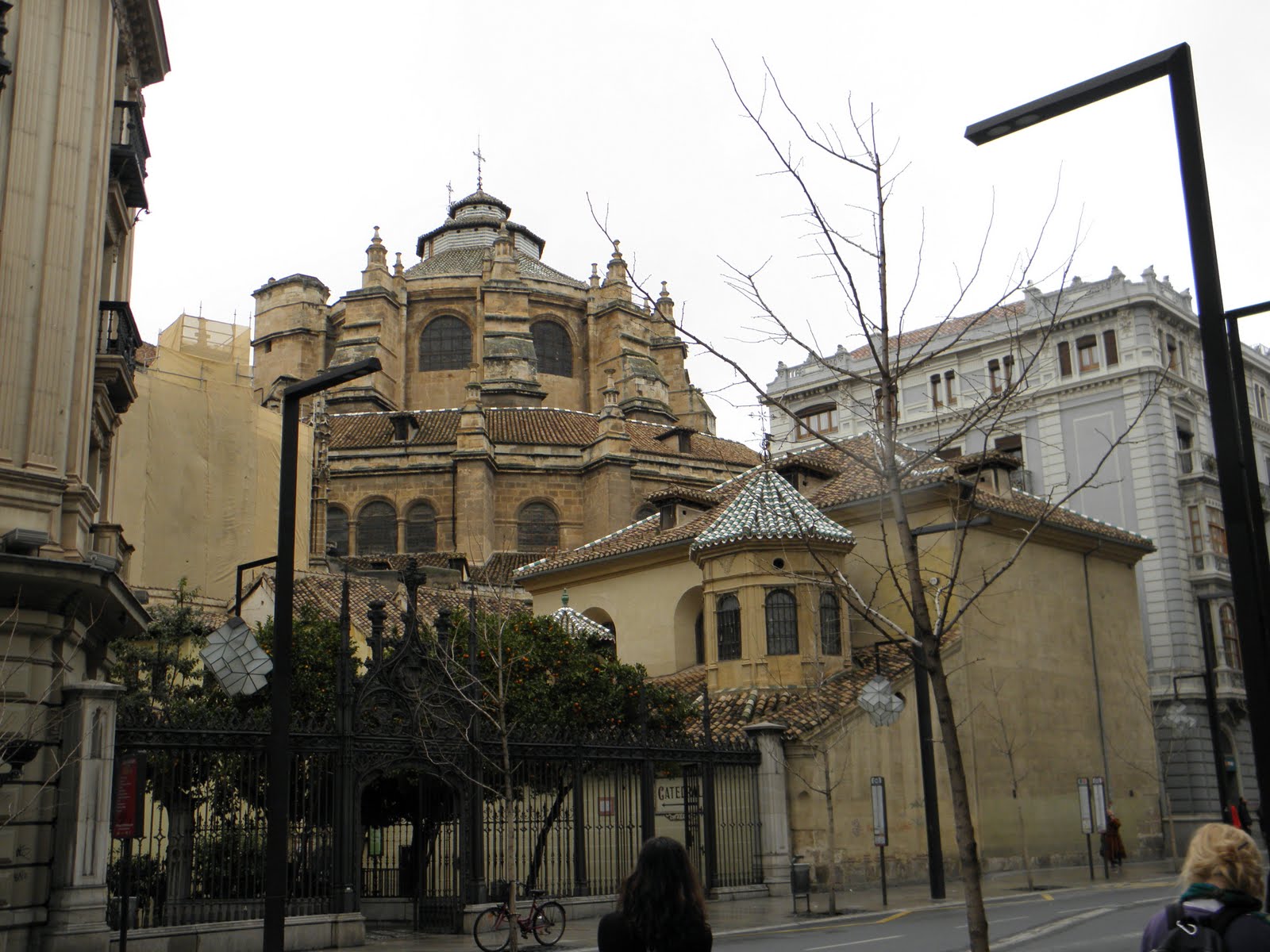
In this picture you can see the circular shape of the Cathedral.
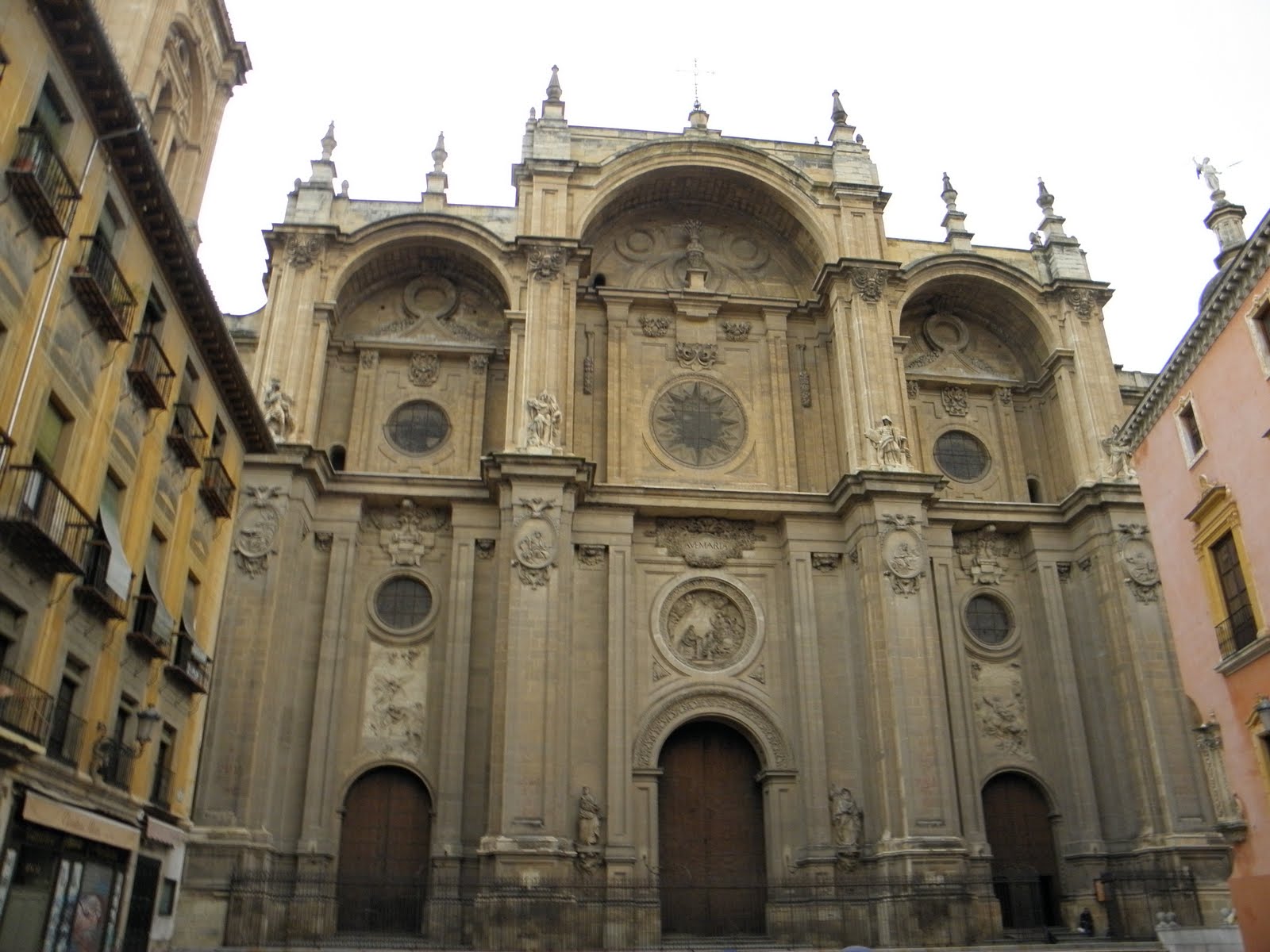
This is one of the old entrances to the Cathedral. These doors are no longer used. 
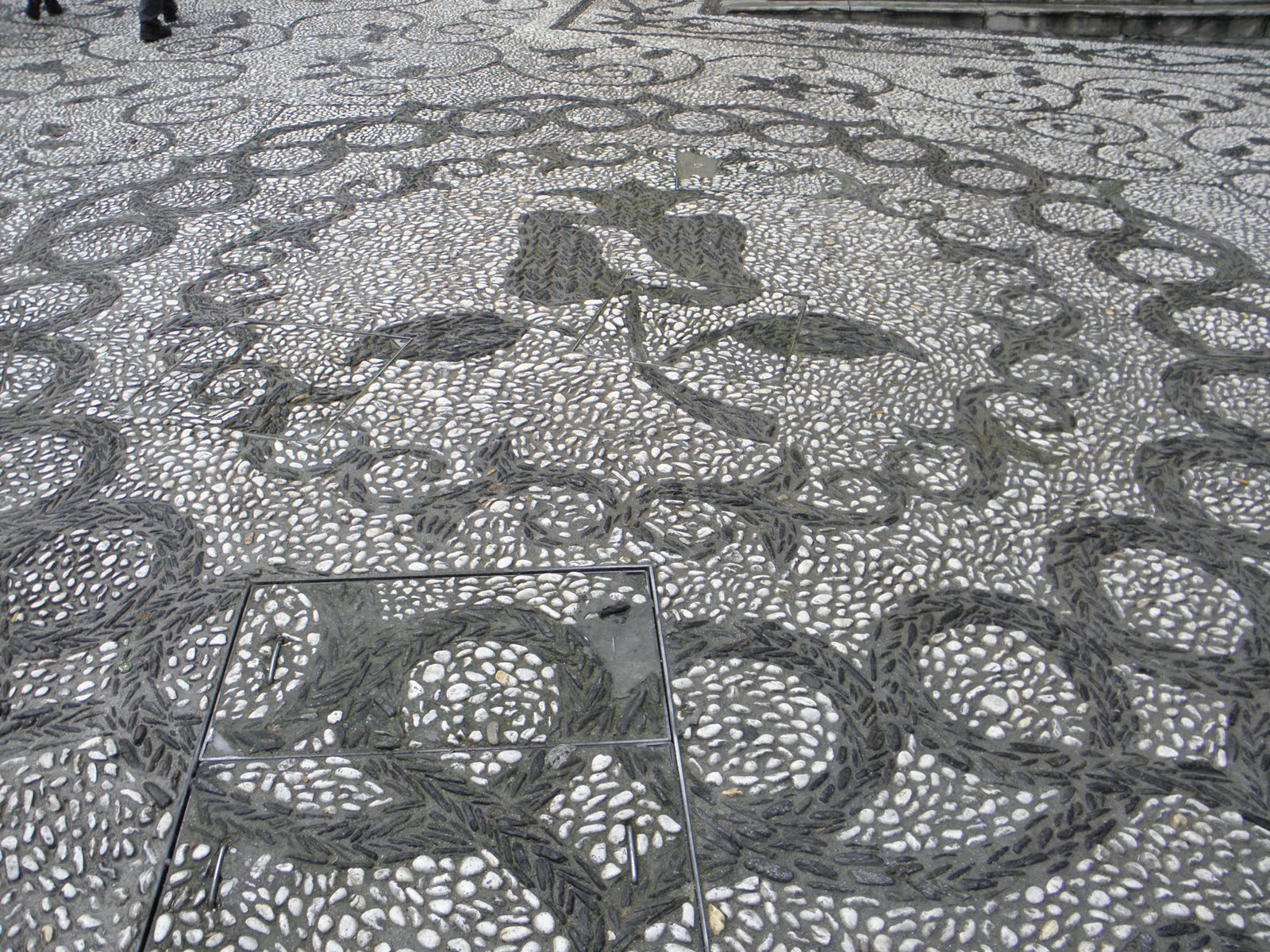
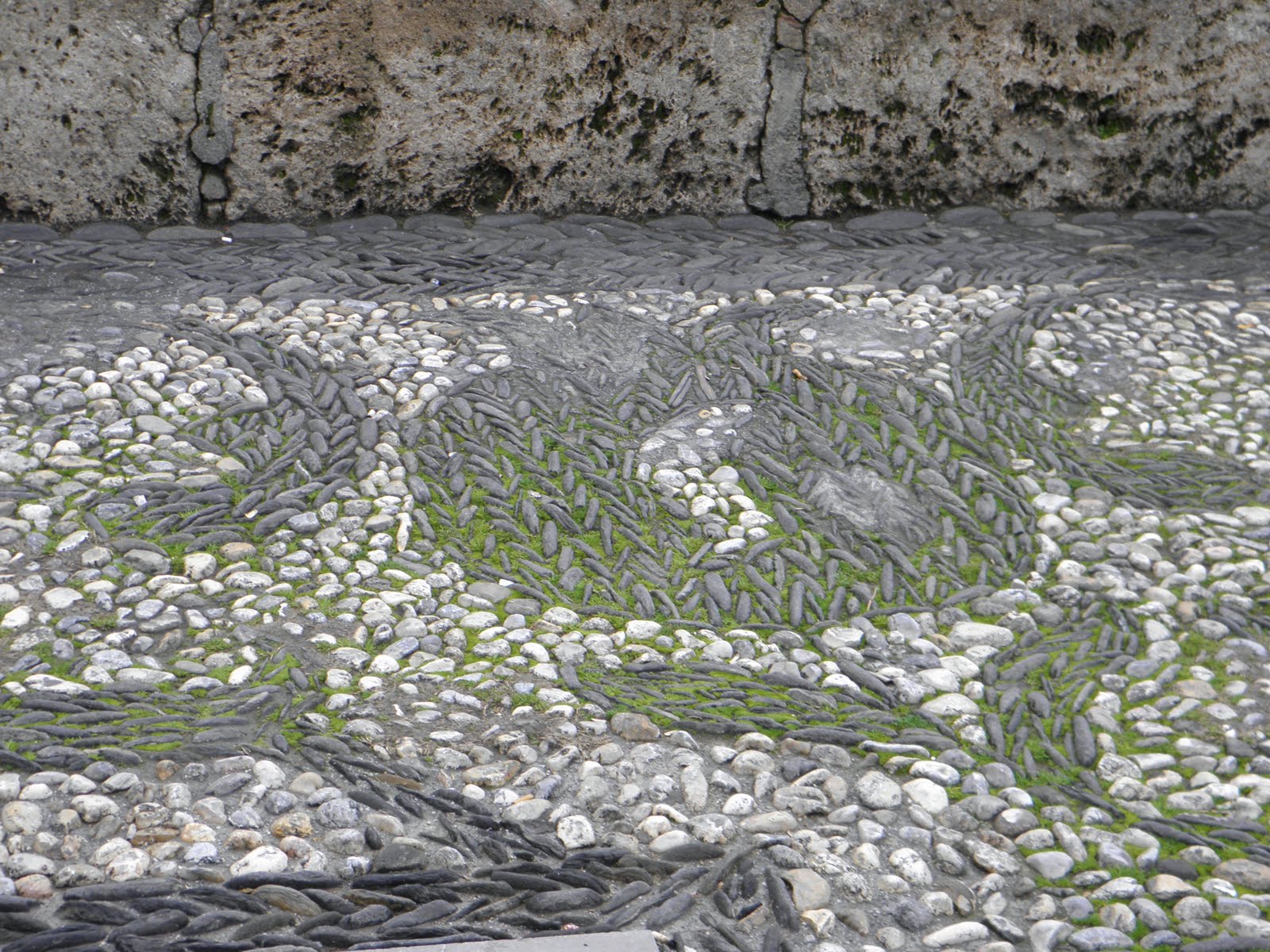
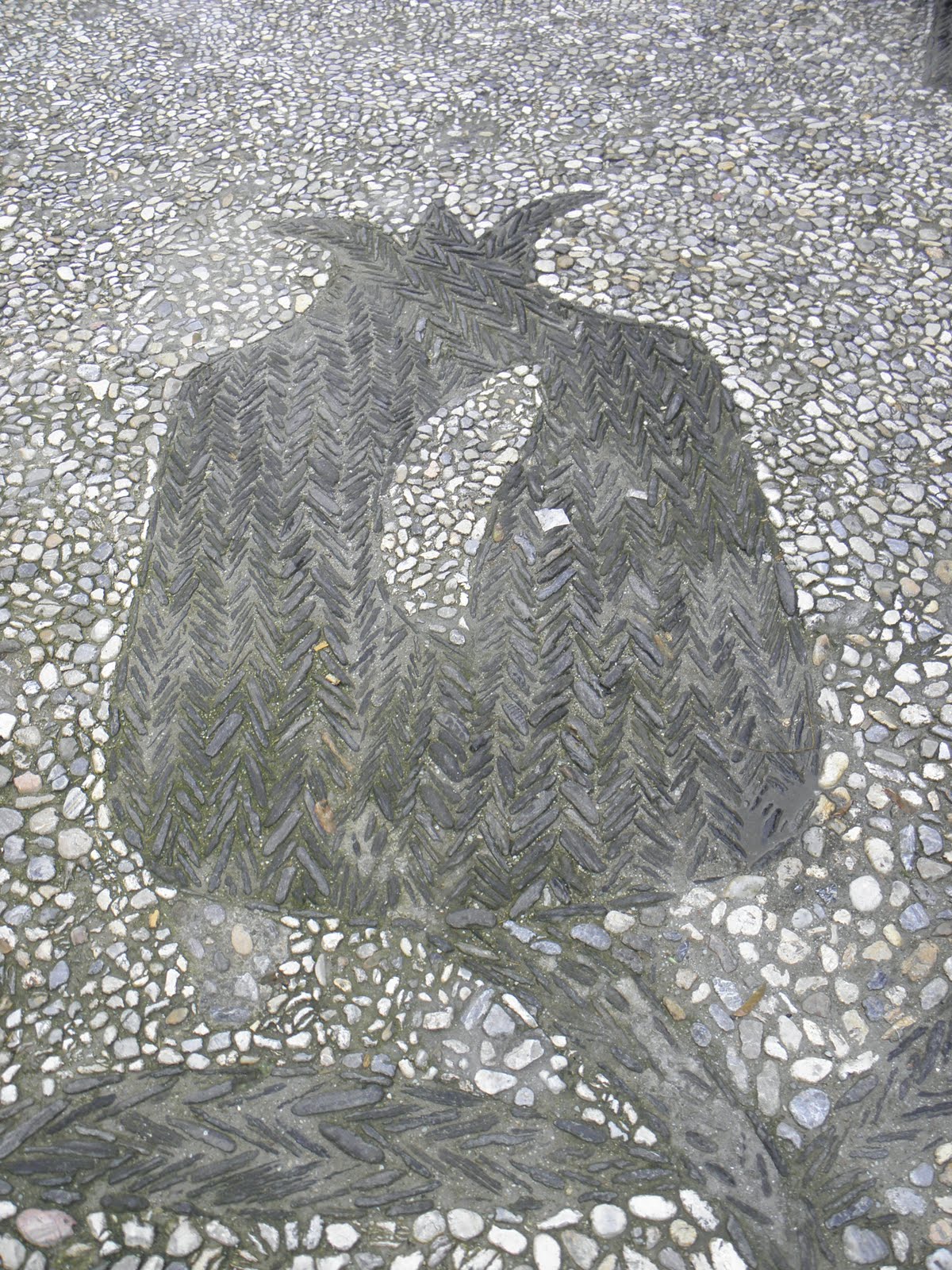
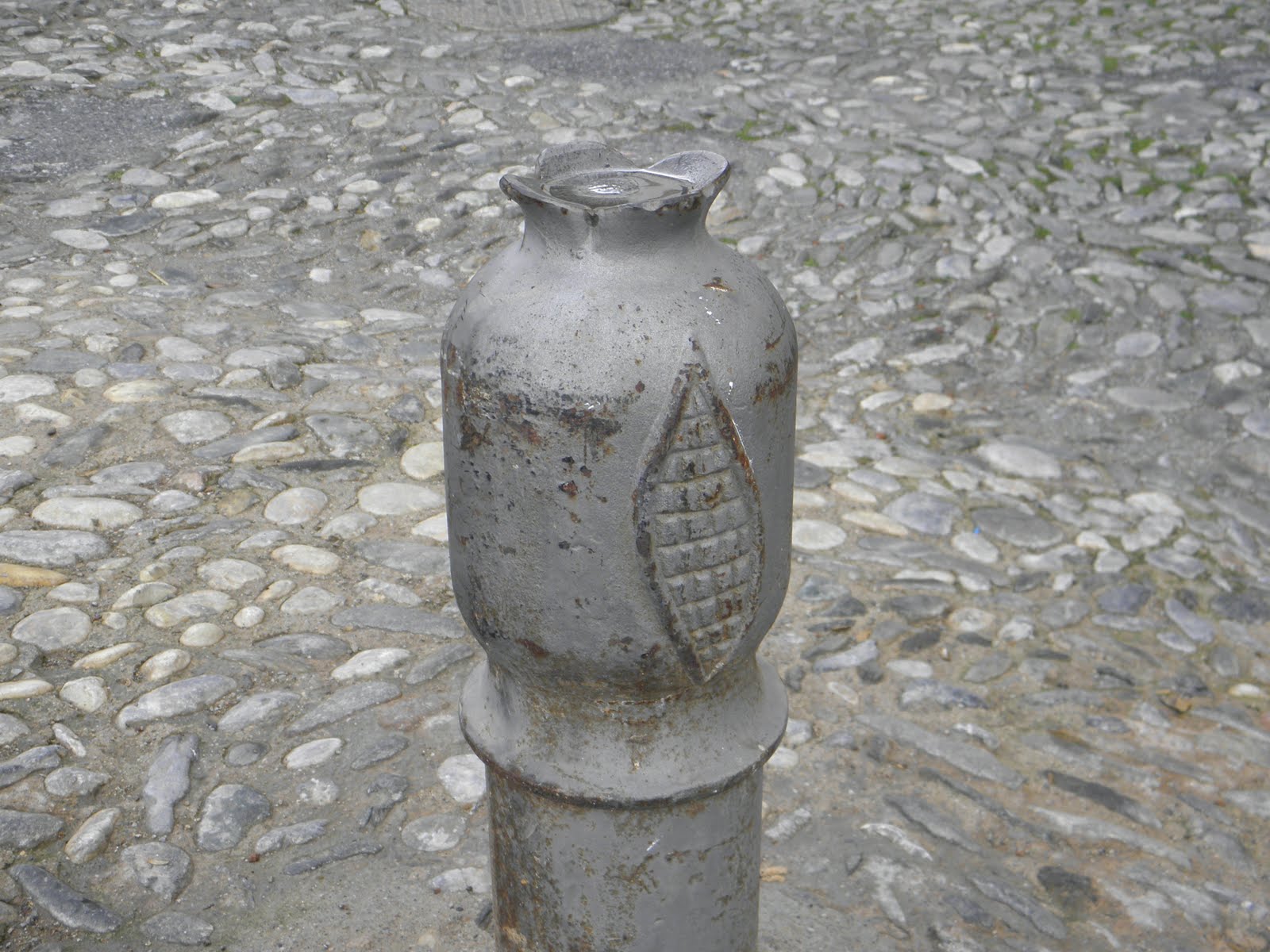
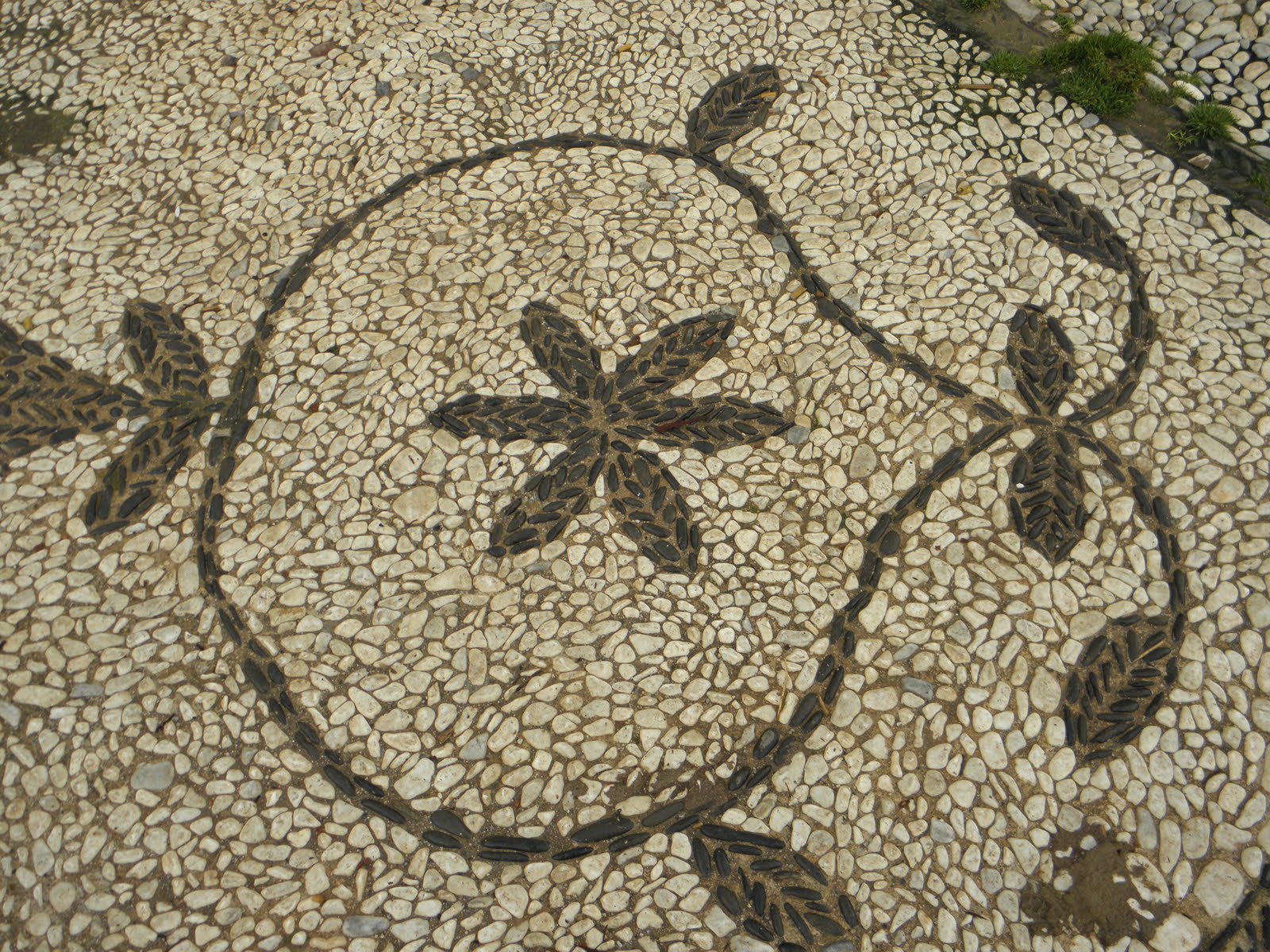
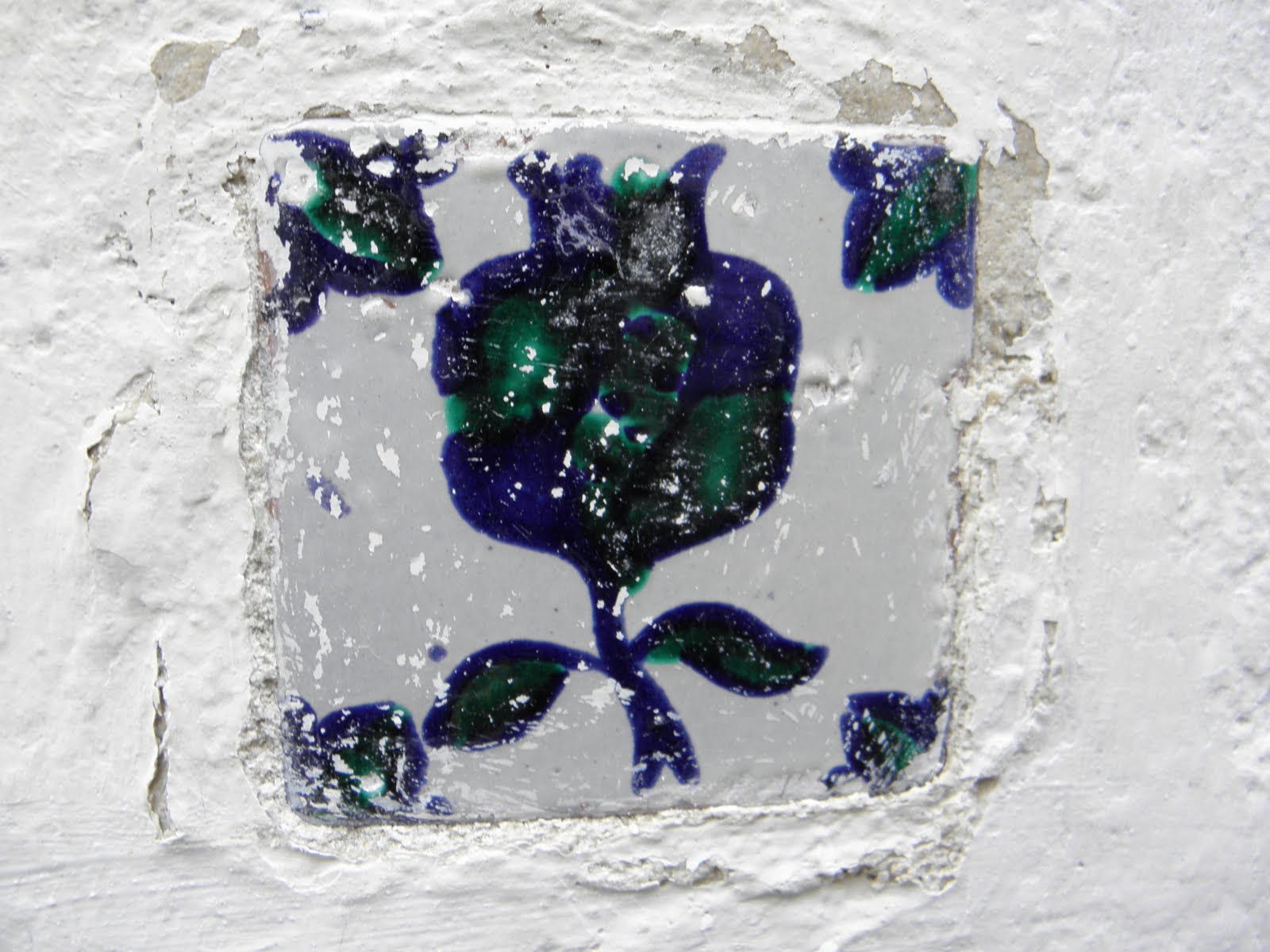
Granda means pomegranate in Spanish and the city is covered in them. Pomegranates are featured in most of the architectural designs and patterns in the tiles and the sidewalks. It's become a game to spot the pomegranates.


Thursday, January 27, 2011

Thunder Snow

So if things had gone according to plan, I would already be in Granada, Spain right now, a day early for orientation, catching up on sleep or hanging out with the two other girls scheduled to arrive early. Of course that would be too easy. Instead this happened:
Thunder Snow Yahoo News Article
Here's how the day went. My mom rushes in at 9:30am and wakes me up. I wasn't planning to get up until 10 because my flight wasn't scheduled to leave until 3:50. I thought I had plenty of time. Turns out I was wrong, my flight had been canceled due to bad weather conditions in Philadelphia. Because of the previous blog post, I was luckily already completely packed and ready to go, all I had to do was get dressed, which I did in like 5 seconds and then got on the phone with US Airways to schedule a new flight while simultaneously searching for one on their website. After searching online and being on hold I found a flight that was supposed to leave at 11:30 that had not yet been canceled. I was still on hold however, so my parents and I decided to just drive to the airport and talk to the US Airways people there. I was still on hold 45 minutes later when the guy at the desk switched my ticket. The 11:30 flight was scheduled to leave at 2:00pm...no that is not a typo. This would give me plenty of time to get to Philadelphia and make my connecting flight to Madrid. Ha

My parents and I went and got lunch at Bob Evans and then headed back to the airport. Said my goodbyes, took some pictures. Security was a breeze because I had everything ready. The woman in front of me did throw a fit about having to throw out her yogurt because it was over 3 ounces but that didn't hold things up too much. So I get to my gate and wait. and wait. and wait. My 11:30/2:00pm flight has been delayed further. But the 8am flight was getting ready to go. So at about 3, I was switched to the 8am flight and got right on to fly to Philly. There was maybe 10 people on this plane, I had my own little 2 seat section, it was very nice. 

Once in Philly, I think ok everything is smooth sailing from here. My Madrid flight is still listed as on time. We board at 5:30, set to go at 6:35. And then the plane never leaves boarding area. It starts to rain. The rain becomes ice. The pilot announces we have to wait for the plane to be de-iced. After an hour, he comes back on and says that the runways are slippery and the plane still needs to be de-iced. After 2 and 1/2 hours, he announces that the flight has been canceled and we have to get off. All flights out of Philly had been canceled. The US Airways woman told us that unfortunately we were one of the last planes to be deboarded and so all the hotels and motels in the area were already full.. We were allowed to keep our pillows and blankets from the plain though. They aren't much, but they were much better than nothing. We all had to call a special US Airways service line to get booked on the next flight to Madrid which isn't until 6pm today. I talked to Debbie from US Airways and she was extremely helpful. Not only did she book my US Airways flight to Madrid, she also called Iberia, the airline I was flying from Madrid to Granada and explained the whole situation and had them switch my flight as well. She was on and off the phone with them for about 30 minutes because they weren't very understanding. I am very grateful to Debbie because if they wouldn't cooperate with her, they sure weren't gonna listen to me. 

So here's the fun part. We all got to sleep in the airport. People were everywhere, it looked like a homeless shelter. The benches were not ideal for sleeping because of the arm rests, but people got pretty creative. 

using lugage as a leg prop
sleeping near the wall
some people got the heat blankets, I dunno what's better
the blue blankets were not very warm but they were soft
These are warm but plasticy and crinkly.
I am not very good at sleeping in public places. I started out here:

 
After about an hour of sitting on top with the uncomfortable arm rests, I moved to underneath the bench. This was alot better, it was darker and more secluded. I slept from 1am to about 2am under the bench. I was wide awake when I woke up at 2 so I packed up my stuff and wandered around a bit. I ended up like 20 gates down and I had seen a few people push two benches together and sleep on them that way. I managed to sleep like that from 4:30 to 6:30. After that I just went and got coffee. Everyone looked like zombies in the morning. People were just walking around with this dazed look like they didn't know where to go or what to do. Everyone was tired and looked like they had spent the night outside or something. 
There is not all that much to do in an airport. I've been wandering around, reading, doing puzzles in an activity book and facebooking all day and I am bored out of my mind. I have 2 and 1/2 hours left until I board my plane to Madrid. I have discovered some interesting things about the airport though. There is a lego replica of the Liberty Bell. There are 10 different Brookstone stores. There are very nice rocking chairs in wing B. I've spent quite a bit of time on one today. 
This is where I watched the sunrise.
Was not on my list of things to do, but since I was up I figured I might as well. 
I also found a fun little gift shop where I got Jerrie the coolest thing ever! 
Its a voodoo doll. There was like 50 different ones, it took me forever to choose which one I was gonna get. I absolutely love it. And no Jerrie, I will not be posting all your presents on here, just this one cuz its so awesome. :)

That's pretty much it. Hopefully the rest of the day goes smoothly and I'm in Granada by tomorrow afternoon. 

P.S. Some of you have been asking about leaving comments. If you click on the title of the post, it opens a new window that contains the post and at the very bottom a comment box :)


Tuesday, January 25, 2011

All my bags are packed

Exactly 24 hours from now I will be on board a plane heading to Morocco. Well technically Philadelphia but its on the way haha I am completely packed, all I have left to do is some picking up in my room and I am ready to go.


Part of the idea of this blog is to help other students who are traveling or planning to travel. I discussed earlier that I would explain everything I'm packing and then later on, have another post about what worked, what didn't, and what i never wore.

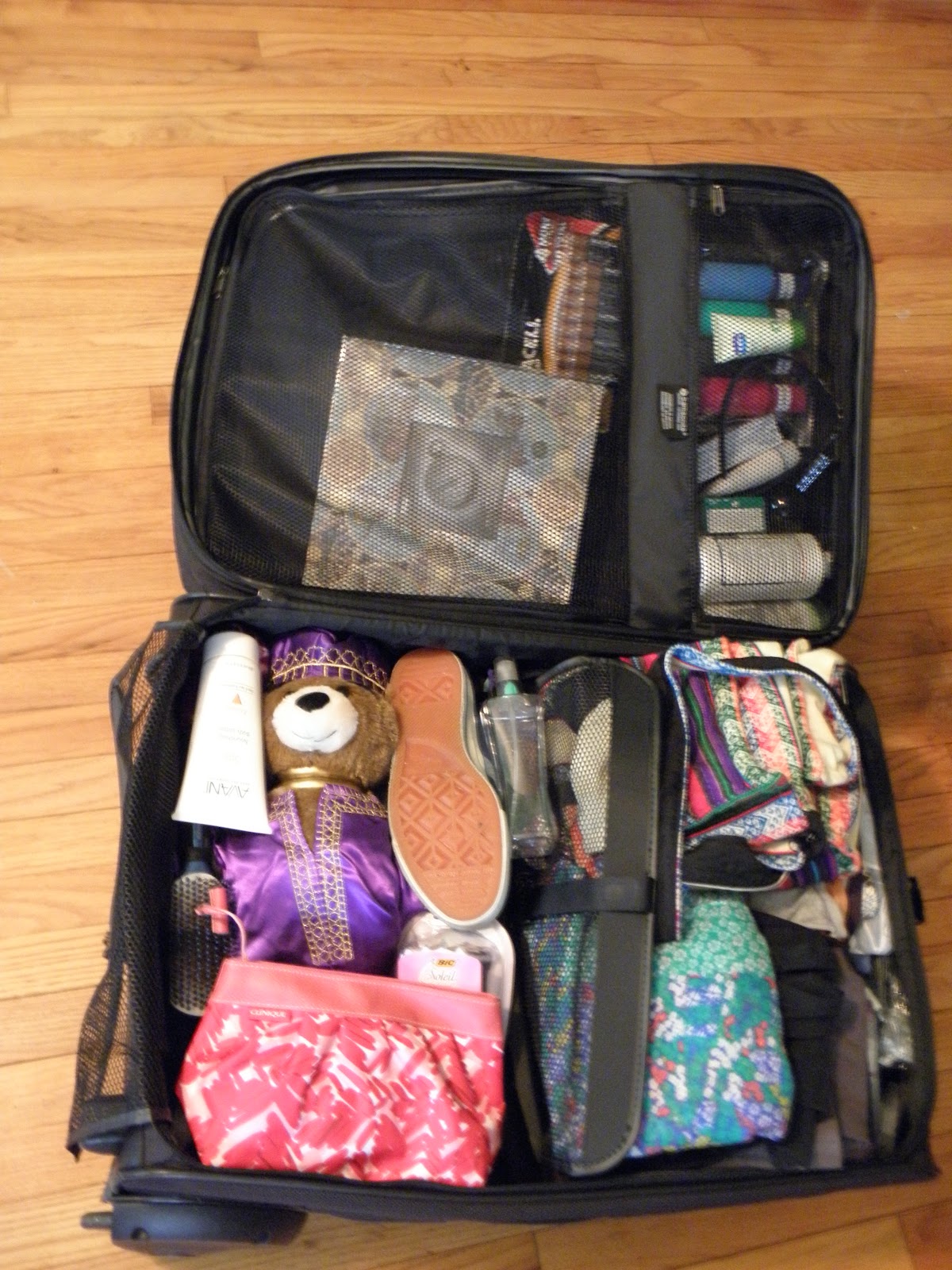
My things are divided among my one suitcase, my carry on and what I am wearing tomorrow. In total I will have 3 pairs of jeans, 1 pair of shorts,  14 shirts, 20 pairs of underwear, 20 pairs of socks, 4 bras (one sports bra) 2 casual skirts (one of which can be paired with a nice shirt to make up my dressy outfit), 2 casual dresses, 5 tank tops/camis for layering, 4 light weight sweaters, 3 scarves ( I wear one almost every day, but I plan to get new ones), a small amount of jewelry and make up, 3 ounce sized containers of lotion, shampoo, conditioner, and body soap, 1 package of razors, travel documents, copies of travel documents, 3 extra pairs of contact lenses, 1 pair of tennis shoes, 1 pair of black flats, 1 pair of flip flops, and 1 other pair of flats, pictures of my family and friends, Omari the Bear, 2 arabic textbooks, a book to read on the plane, a journal, an empty photo album, my laptop and power cord, camera and power cord, 3 bottles of nail polish, my glasses, bobby pins, hair bands, feminine supplies, batteries, power strip, address book, a rosary (I never travel without one), day planner, and my winter coat. I think thats everything haha.

Carry on

Suit Case
My carry on has an extra outfit with multiple pairs of socks and underwear in case airline workers go on strike or something and I can't get my checked bag. My actual travel documents are also in the carry on and the copies are in the suitcase. My carry on also has a book, the journal, the camera, 1 extra pair of contacts, my laptop, 1 bottle of nail polish, glasses, hair stuff, feminine supplies, batteries for the camera, address book, and the rosary. I will be wearing jeans, flats, a cami, a shirt, a sweater and my winter coat. The coat will be bulky to have on but it saves room in the suitcase to wear it. The flats are better than the tennis shoes because they slip on and off. This makes the security line alot easier.

Hopefully security goes smoothly. My carry on isn't a TSA approved laptop case, but all that means is I have to take my laptop out when I go through security. I'm going to have alot of airport time for the next two days.
Good bye for now :) but keep checking back, this might be last post until Morocco, but I might also post something in Spain.