I was walkin' down the street
In the town where I was born
I was movin' to a beat
That I'd never felt before
I have been unable to find a comprehensive timeline of the events going on in Libya. Instead I will summarize a few articles that discuss the major events of the Libyan Revolution. Protests began on February 17,2011, named the Day of Anger by groups who used social networking sites to organize.
Gaddafi Hits With Deadly Force
Gaddafi wasted no time in responding violently to the protests. Just four days in and the death toll is upwards of 300. Gaddafi's forces are firing straight on crowds of protesters with no hesitation. The protests are located mainly in the eastern cities of Benghazi, Baida, Ajdabiya, Zawiya and Derna. They will eventually spread to the capital, Tripoli. Already Libyans are frustrated with the lack of international intervention or support because of the rising number of deaths. "Italian Prime Minister Silvio Berlusconi said Saturday he will not "bother" Gaddafi over the violent incidents."
So I opened up my eyes
And I took a look around
I saw it written 'cross the sky
Gaddafi blames unrest on al-Qaeda
This article just proves the craziness of the Libya leader. In a speech on February 24, 2011, Gaddafi proclaimed that Al-Qaeda had drugged his people and then incited them to revolt. The young people were supposedly given hallucinogenic drugs in their NesCafe(a popular brand of instant coffee in North Africa) and that is why they are protesting, revolting, and calling for a revolution. Gaddafi also claims that he is more of a symbolic leader and that there is representation for all his people. However, if this were true, than he would have much less of a problem stepping down and would not have had the ability to order the military to shoot on its own people.
The Revolution starts now
yeah, the revolution starts now
As Gaddafi wages war against a popular uprising, Libyan exiles explain how terror has long been a tool of the regime.
This is a video that details the events of the revolution and gives insight to the regime's general practices through the eyes of exiles living abroad. The first video shows a clip of one of Gaddafi's speeches in which he states "I have my gun and I will fight until the last drop of blood" and "We will march in the millions to cleanse Libya inch by inch, house by house, street by street, person by person."
Witnesses of Gaddafi's regime who have been in exile since the 1970s talk about instances of protest in which students were shot, killed and hung in front of their friends and family. They have been waiting in exile for Gaddafi to be removed from power so that they can one day return to Libya and live without fear. Even in exile they are not safe. Gaddafi has hitmen sent all around the world to stop his dissidents.
There are five different people in exile and each give their accounts. Each one also has a small biography listed below the main video.This video gives a very good depiction and the general idea of the Libyans in exile can be understood. This video is a good 30 minutes long, but well worth it.
The revolution starts now
When you rise above your fear
Obama: Its time for Libya's Gaddafi to Go
On February 27, 2011, President Obama and Germany's Chancellor, Angela Merkel had a telephone meeting about the situation in Libya. Up until this speech, the US response to the revolution was very non committal. There were legitimate reasons for this hesitancy however. US citizens who were in Libya for whatever reason, needed to be gotten out safely before the US took a definitive stance on the issue. Those citizens could have been put in great danger in the US had immediately supported the rebel groups. This speech calls on Gaddafi to stop massacring his people and to step down. Obama states that the Libyan people have spoken and that their wishes should be respected. No government has the right to rule without the approval of its citizens.
And tear the walls around you down
The revolution starts here
Libya: The Propaganda War
This video discusses the idea of proaganda. The situation in Libya has been greatly effected by media from both sides of the conflict. Each side has its own propaganda that it is promoting and truth can sometimes be difficult to find. The video also talks about how specific words are very important in a conflict like this, for example choosing to call this a civil war is much different than calling it an uprising or a revolution. Very good video, you only need to watch the first 10 minutes.
Where you work and where you play
Where you lay your money down
What you do and what you say
The revolution starts now
Yeah the revolution starts now
UN Authorizes No Fly Zone Over Libya
After what some may say was too long of a hesitation, the UN has authorized the military enforcement of a "No-Fly Zone" over Libya so that Gaddafi's forces will be severely limited in attacking the people. The United States and France were to lead the military efforts temporarily until another international organization like NATO is able to take control. Gaddafi's land forces are also allowed to be interrupted militarily if there is a threat to the Libyan people. The goal, however, is not to kill Gaddafi or force him to give up power through military means. Economic sanctions and social pressure are the means that individual countries can use to convince Gaddafi to step down.
Obama Strongly Defends US Military Action in Lbya
President Obama has come under fire for his decision to send troops to Libya in support of the UN's decision on a "No-Fly Zone". Many in the US are wondering why the US is involved in another Middle East conflict and are reluctant to support this cause. Obama has made it clear that this is not a forced regime change like that in Iraq. The US troops are there for the purposes of the UN's initiative and for nothing else. "Some nations may be able to turn a blind eye to atrocities in other countries. The United States of America is different. And as president, I refused to wait for the images of slaughter and mass graves before taking action."
Yeah the revolution starts now
In your own backyard
In your own home town
so what are you doin' standin' around?
Just follow your heart
The revolution starts now
Mapping Libya's Uprising
If you would like to keep up with the Libya conflict, here is a very helpful map. It charts all the cities and territories in Libya that are in the news and marks who is in control of what.
Tuesday, March 29, 2011


Friday, March 18, 2011
Young People Speaking Their Minds Part 2/4
There's battle lines being drawn
Nobody's right if everyone is wrong
Egyptian Revolution's Timeline:
January 25,2011- Inspired by the successful revolution in Tunisia, and organized with the help of social networking sites, Egyptians declare a "Day of Rage"
"thousands began taking to the streets to protest poverty, rampant unemployment, government corruption and autocratic governance of President Hosni Mubarak, who has ruled the country for 30 years. These were the first protests on such a large scale in Egypt since the 1970s."Huffingtonpost.com
"Police responded with blasts from water cannons and set upon crowds with batons and acrid clouds of tear gas to clear demonstrators crying out "Down with Mubarak" and demanding an end to Egypt's grinding poverty, corruption, unemployment and police abuses."huffingtonpost.com
This was seen as a pretty mild response due to the regime's reputation for swiftly and harshly stifling any forms of decent. World attention and the overthrow of the Tunisian president meant that the Egyptian government had to respond with caution.
Young people speaking their minds
Getting so much resistance from behind
January 26-28,2011- Protests continue along with increasingly violent responses from the police. Internet and cell phone services are being disrupted, especially social networking sites like Twitter and Facebook.
"Blocking Twitter not only enraged Egyptian citizens; it also brought increased national attention to the uprising. Over the course of the next two days, Egypt proceeded to block Facebook while the much-hated riot police took to the streets, arresting and injuring hundreds with batons, tear gas water cannons. Protests occurred not only in Cairo, the capital, but also in Alexandria and Suez, two other major cities." huffingtonpost.com
The use of social networking sites to organize and build of knowledge of the protests and revolution show that these are the young people standing up for what they believe. They have grown up and learned that life without civil liberties sucks and they are sick of it. Many countries in the Middle East and North Africa have a demographic situation called a "Youth Bulge" meaning there is a disproportionate amount of young people. There large numbers create countrywide and longterm problems, like food shortages, not enough jobs for degree holders, and a lack of jobs in general. Their large numbers have also influenced their ability to protest and revolt.
I think its time we stop, hey , what's that sound
Everybody look what's going down
January 29, 2011- President Mubarak announces that he has fired his cabinet, appointed a vice-president, but still refuses to step down. Looters have begun to destroy the nations tourist attractions which are key sources of revenue. The US has begun to encourage its citizens to leave the country for their own safety as protesting, looting, and military intervention continue.
January 31, 2011- Protesters have been camping out in Tahrir Square for days, ignoring the militarily imposed curfew. The US puts out a mild statement of dissent about Mubarak's actions stating that the needs of the people need to be addressed. Internet and cell-phone services are only sometimes functional.
February 1,2011- Mubarak announces that he will not run for re-election at the end of his term, but that he will also not step down early.
"Number of protesters in Cairo's Tahrir Square are revised to more than a million people. Thousands more take to the streets throughout Egypt, including in Alexandria and Suez." english.aljazeera.net
What a field day for the heat
A thousand people in the street
February 2- 10, 2011- Day of protesting in Tahrir Square and in other major cities around the country. Violent clashes between Mubarak supporters and the protesters result in many deaths, but the people do not give up and they do not go home. Government ministers and officials are resigning from their posts to join the protesters. The Muslim Brotherhood has sided with the protesters. Every day is a struggle, Mubarak refuses to step down despite the increasing pressure to do so. The Egyptian people, the youth, have made their decision and they will not go home until their demands are met, until Mubarak steps down.
February 11,2011- The people have won, Mubarak finally steps down. The announcement is made by his newly appointed vice president, Omar Suleiman. Power has been handed over to the army until a new government can be formed.
Singing songs and carrying signs
Mostly say hooray for our side
For the next week or so, people continue to remain in Tahrir Square to celebrate their victory. After a few days, the army steps in and begins to clear people out so that the square can be cleaned up and order restored. The country is now trying to form a democracy. This will not be easy, and the results will not be perfect, but the people are determined.
For the next week or so, people continue to remain in Tahrir Square to celebrate their victory. After a few days, the army steps in and begins to clear people out so that the square can be cleaned up and order restored. The country is now trying to form a democracy. This will not be easy, and the results will not be perfect, but the people are determined.
Its time we stop, hey, what's that sound?
Everybody look what's going down
Tuesday, March 15, 2011
Everybody Look What's Going Down Part 1/4
There's something happening here,
What it is ain't exactly clear
The Merriam-Webster Dictionary:
Revolution(noun)- 2b. a fundamental change in a political organization; especially the overthrow or renunciation of one government or ruler and the substitution of another government or ruler.
Protest(noun)- 2. The act of objecting or a gesture of disapproval especially: a usually organized public demonstration of disapproval.
Timeline of Tunisia's Jasmine Revolution:
December 17, 2010- Mohammed Bouazazi douses himself in paint thinner and then sets himself on fire in front of a local municipal office in Sidi Bouzid in protest of police brutality, a lack of human rights, job loss, and overall poverty. This sparked more protests all around the country.
December 20, 2010- A 10 million dollar employment program is offered to Sidi Bouzid in a failed attempt to appease the protesters.
December 22, 2010- Houcine Fahli electrocutes himself in protest of unemployment
December 24, 2010- Hundreds of protesters are gathering in cities all around Tunisia, security forces stage an overnight crack down, two more people have died for the cause.
December 27, 2010- 1,000 Tunisian gather in protest in Tunis, the capital.
December 28th,2010- Zine El Abidine Ben Ali, the country's president of 23 years, condemns the protests and states that they are the acts of extremists. In the mean time, many prominent members of society, such as lawyers and government ministers, are siding with the protesters and subsequently losing their jobs and some are also arrested.
December 31,2010- more have joined the protests because of the wrongly imprisoned lawyers, authorities respond with increasing violence
January 2,2011- a cyberactivist group sides with the protesters and temporarily jams the government's internet services and websites.
January 3,2011- a group of 250 students protest in Thala, the police use tear gas to break up the protest. The protesters then respond by setting fire to local government buildings.
January 5, 2011- Mohammed Bouazazi dies from his self-inflicted burns.
January 6,2011- 95% of lawyers in Tunisia go on strike in order to end police brutality against peaceful protesters.
January 7-12, 2011- Journalists, bloggers, and activists are arrested. Protests are broken up using tear gas and water cannons. When these fail, the authorities resort to violence, including the use of snipers on protesters in two major cities. These actions lead the people to move from the mindset of peaceful protesting to revolution.
January 13,2011- the death toll is at 66. The president gives a televised address to the people announcing concessions and his plans to not run for reelection in 2014.
January 14,2011- The president declares a state of emergency because protests have not stopped. He makes promises about legislation to calm down the protesters, but it is too little too late. Gatherings of more than 3 people are now banned and the police have approval to respond with arms if emergency orders are violated. In accordance with state of emergency rules, the prime minister, Mohammed Ghannouchi, takes temporary control of the government. In the meantime, Ben Ali- the president flees to Saudi Arabia
Jan 15-17,2011- the absence of an official leader leads to massive rioting, looting and chaos. The military is asked to step in to restore order. "Ghannouchi also announces widespread reforms, promising press freedom, the lifting of a ban on human rights groups operating in Tunisia, and the release of political prisoners." And an interim government is appointed, but many of the members of the interim government are leftovers from Ben Ali's regime so the people are not pleased.
January 23,2011- hundreds of people flock to the capital to protest the interim government and to defy the State of Emergency curfews and gathering rules
January 24-27,2011- Continued protests result in violent attacks by riot police, the resignation of the foreign minister, and the removal of Ben Ali supporters from the interim government.
February 27,2011- After a month of continued protests, Ghannouchi also resigned.
Al Jazeera English
"The revolution, as Tunisians call it, also has created a power vacuum, and Tunisia faces enormous challenges in rebuilding its political system. The country’s caretaker government has been confronted with nearly daily protests by a variety of groups, the police force has been badly weakened by mass desertions and the firing of top officials, and provincial government offices remain dysfunctional. The judicial system is hobbled by its links to the ousted regime." NY Times
Tunisia's interim government is still trying to build order and prevent the country from falling into anarchy while preparing for mid-term elections.
I think its time we stop, children, whats that sound?
What it is ain't exactly clear
The Merriam-Webster Dictionary:
Revolution(noun)- 2b. a fundamental change in a political organization; especially the overthrow or renunciation of one government or ruler and the substitution of another government or ruler.
Protest(noun)- 2. The act of objecting or a gesture of disapproval especially: a usually organized public demonstration of disapproval.
There's a man with a gun over there,
Telling me I got to beware
Timeline of Tunisia's Jasmine Revolution:
December 17, 2010- Mohammed Bouazazi douses himself in paint thinner and then sets himself on fire in front of a local municipal office in Sidi Bouzid in protest of police brutality, a lack of human rights, job loss, and overall poverty. This sparked more protests all around the country.
December 20, 2010- A 10 million dollar employment program is offered to Sidi Bouzid in a failed attempt to appease the protesters.
December 22, 2010- Houcine Fahli electrocutes himself in protest of unemployment
December 24, 2010- Hundreds of protesters are gathering in cities all around Tunisia, security forces stage an overnight crack down, two more people have died for the cause.
December 27, 2010- 1,000 Tunisian gather in protest in Tunis, the capital.
December 28th,2010- Zine El Abidine Ben Ali, the country's president of 23 years, condemns the protests and states that they are the acts of extremists. In the mean time, many prominent members of society, such as lawyers and government ministers, are siding with the protesters and subsequently losing their jobs and some are also arrested.
December 31,2010- more have joined the protests because of the wrongly imprisoned lawyers, authorities respond with increasing violence
January 2,2011- a cyberactivist group sides with the protesters and temporarily jams the government's internet services and websites.
January 3,2011- a group of 250 students protest in Thala, the police use tear gas to break up the protest. The protesters then respond by setting fire to local government buildings.
January 5, 2011- Mohammed Bouazazi dies from his self-inflicted burns.
January 6,2011- 95% of lawyers in Tunisia go on strike in order to end police brutality against peaceful protesters.
January 7-12, 2011- Journalists, bloggers, and activists are arrested. Protests are broken up using tear gas and water cannons. When these fail, the authorities resort to violence, including the use of snipers on protesters in two major cities. These actions lead the people to move from the mindset of peaceful protesting to revolution.
January 13,2011- the death toll is at 66. The president gives a televised address to the people announcing concessions and his plans to not run for reelection in 2014.
January 14,2011- The president declares a state of emergency because protests have not stopped. He makes promises about legislation to calm down the protesters, but it is too little too late. Gatherings of more than 3 people are now banned and the police have approval to respond with arms if emergency orders are violated. In accordance with state of emergency rules, the prime minister, Mohammed Ghannouchi, takes temporary control of the government. In the meantime, Ben Ali- the president flees to Saudi Arabia
Jan 15-17,2011- the absence of an official leader leads to massive rioting, looting and chaos. The military is asked to step in to restore order. "Ghannouchi also announces widespread reforms, promising press freedom, the lifting of a ban on human rights groups operating in Tunisia, and the release of political prisoners." And an interim government is appointed, but many of the members of the interim government are leftovers from Ben Ali's regime so the people are not pleased.
January 23,2011- hundreds of people flock to the capital to protest the interim government and to defy the State of Emergency curfews and gathering rules
January 24-27,2011- Continued protests result in violent attacks by riot police, the resignation of the foreign minister, and the removal of Ben Ali supporters from the interim government.
February 27,2011- After a month of continued protests, Ghannouchi also resigned.
Al Jazeera English
"The revolution, as Tunisians call it, also has created a power vacuum, and Tunisia faces enormous challenges in rebuilding its political system. The country’s caretaker government has been confronted with nearly daily protests by a variety of groups, the police force has been badly weakened by mass desertions and the firing of top officials, and provincial government offices remain dysfunctional. The judicial system is hobbled by its links to the ousted regime." NY Times
Tunisia's interim government is still trying to build order and prevent the country from falling into anarchy while preparing for mid-term elections.
I think its time we stop, children, whats that sound?
Everybody look what's going down
Tuesday, March 8, 2011
Slam au Fémínín
(Video loads may be slow so scroll down and start loading them while you read the text)
This last Thursday, I had the amazing opportunity to go to a Moroccan women’s feminist poetry slam put on by my university and an well-known spoken word poet, Roxy Azari. Roxy Azari is an Iranian-American spoken word poet whose main topics are gender issues and feminism, and occasionally strife in the Middle East. You can find out more about her on her facebook page here: Roxy's Facebook Fan Page
She has started many spoken word poetry workshops in schools all around the US. She encourages young people to use their voices and their words to institute social change in the world. Roxy was awarded the Watson Fellowship which has enabled her to run these workshops with girls around the world. She began in India, then the UAE, then Indonesia and for the past three months she has been in Morocco. Now that she has finished in Morocco, she will be moving on to France and then Turkey. With the help of open-minded professors at different universities, she taught the women and girls here how to write and how to perform poetry. Thursday was the performance of all the girls who participated from my university. On Friday, they traveled to Rabat to perform with women from all over the country before a wider audience.
This is Roxy’s poem Azadi(Freedom), She is speaking about the Green Revolution in Iran.
Professor Ouafae Bouzekri was the main coordinator on our campus. She is phenomenal. She teaches my Three Religions, Three Peoples class and often also teaches a Gender Studies class for ISA. She taught in the US for a number of years at prominent universities, speaks fluent English, French and Arabic, and quickly became one of my favorite professors here. She organized the event and got many of the girls interested in participating.
 |
| This is Professor Bouzekri. |
The theme was feminism in Morocco and the Middle East. While Morocco is a liberal country by Middle East standards, it is far from being democratic or liberal by western standards. Women here have very few rights, sexual harassment by strangers is a daily occurrence, and even though the wearing of the veil or head scarf is not mandatory, choosing to wear it or not to wear it can greatly impact a woman’s life. Just by reading the program, I could tell this was going to be a powerful evening. The titles of the poems say so much before the author has even performed.
 |
| Photo courtesy of Roxy Azari |
 |
| Fatima Zahra Kaddar performing Being a Women |
 |
| Two of the girls, posing after the show |
I started out just by taking pictures and writing down memorable lines from the poems, but quickly realized that in order for people to understand how incredibly impactful these poems were, they would need to see them and hear them. The performances of these women are just as important as their words. They are emotion-filled and raw. You can see that each girl truly feels what she wrote and that she is terrified and exhilarated to be presenting her feelings in front of an audience. This is something many of them have never done before and maybe never thought could happen. They live in a society that doesn’t embrace standing out, which emphasizes the status quo. Women are supposed to accept their lives the way they are. But things are changing. Women want rights, they want equality, and they no longer want to be seen has sinful just because they are women. Maybe the string of revolutions in the Middle East has given them courage or maybe they have been ready for their own revolution for a long time.
 |
| Yes, I am a Girl by Nadya Izzamiouine |
 |
| Ode to My Body by Najia Moussaoui, Nouria Sophia, Souad Zamzmi, and Fatima Zahra Kaddar |
These girls stood up on stage and performed their poems about their thoughts, their feelings, their experiences, their hopes and dreams and their bodies. Their stories were personal and meaningful. If I had been in some of these girls’ shoes, I don’t know if I would have had the courage to stand up on stage like they did.
To My Abuser, by Samia Boutoutla was very moving. The poem was written as a girl who had been abused, sexually harassed in the street, something that is very common here. The girl is yelling at her abuser, telling him that all the things he did to her were wrong; asking why he thought it was ok to just attack her and use her. The passion and anger in her voice could be felt by everyone in the audience. The chorus of the poem is “You had no right!” She repeated this often, sometimes soft and sad and other time loud, angry and demanding. The last line of the poem implores the audience to empathize with her, “if you had been there that night, you would say I was right.”

 |
| To My Abuser by Samia Boutoutla |
The next performance was Silence by Kaoutar Kaddar. She talked about wanting to speak up and to say her mind, but of not being able to do so. In the poem she finds her courage and dares to speak despite the consequences. But the line “I’ll say what I have on my mind, just this once” shows that it takes new courage each and every time they choose to speak, not just the first time.
 |
| Silence by Kaoutar Kaddar |
There were women of all ages performing, but most were late teens, early twenties. They spoke in Arabic, French, or English, but no matter what language it was in, the audience could understand their anger and frustration, their strength and their sadness, their joy and their pride.
Where is My Voice by Fatima Zahra Riffi was heartbreaking. She wrote about physical abuse and the effects it has on a woman. I don’t know if she was speaking about her own personal experience or of someone else’s but that doesn’t change the message, physical abuse oppresses women and they become afraid to speak out against their abuser. They become depressed and feel worthless. The whole poem was tragic, but there were 4 lines specifically that hit me hard. “He smacked me strongly, my tears fall to the floor.” “Why is it me that you beat? Is it because I’m the only one you can defeat?” “I am asking God, what is left for me?” and the very last line of the poem “If I kill myself, would God count it as a crime?”


 |
| Where is My Voice by Fatima Zahra Riffi |
Shortly after that poem, I decided to start taking video because I realized that no matter how descriptive I am in writing, actually seeing the performance will be more impact-full. This video is of Sexual Harassment by Lamyae Kani, Fatima Zahra Kroum, and Imane Lahlali. It is about the street harassment that women experience every day. I can personally relate to this one because it happens to me every day. Every time a woman goes anywhere she is bombarded with harassment. This can be anything from the more innocent cat calls to molestation or rape.
This next video is something I think everyone will find particularly interesting. It is called Veil and is done by a group of girls(Dounia Mansouri, Khadija Fadel, Mimouna Nmiri, Fatima Zahrae Ktomi, Latifa Masou, Sophia Nouira, Najia Moussaoui, and Sauad Zemzmi). Each one talks about her reasons for veiling or not veiling. In the US, we have a pretty one-sided view of the veil; veiling equals oppression of women and gender inequality. These girls, however, explain that it is not always oppression. Many of them love their veils because it is an expression of their religious faith. There are also those who do not veil and who view it as an old-fashioned or oppressive symbol. The really amazing part is that veiled or not veiled these women are all friends. It doesn’t matter to them what whether another girl chooses to veil or not to veil.
Revolution by Rajae Neddi was amazing, sadly I did not take a video of this one. Rajae speaks directly to Mubarek and Gaddafi in her poem. She is one of the few poets who used rhymes and they are quite funny at the same time as being direct and straight forward. She begins with “Mr. Mubarek is the picture clear?” and then talks about the Egyptian people. Then she moves on to Libya with “Mr. Gaddafi you are a dictator, you’re turn is coming but a little bit later.” One of the audiences’ favorite lines was “Mr. Gaddafi you’re destined to hell, we hope you forever there dwell.”
Here is I Don’t Need a Man by Kaoutar Kaddar, Fatima Zahra Riffi, Rajae Neddi, and Khadija Masoud. The title pretty much speaks for itself on this one.
Roxy performed again towards the end. She is very modest about her work. She really wanted the focus of the evening to be about the girls, but because of her celebrity, she was asked to perform quite a few of her poems. This is one of her more famous poems. It is called Flower. I had heard this before, in the US, although I do not remember when or where. Roxy’s poems are well-written, thought provoking, and emotional. Her performance is beautiful. When she performs the entire audience is enveloped into her words and everyone is experiencing her feelings.
This was just a tiny portion of the 4 hour event, every minute of which I was listening intently on the edge of my seat. There were quite a few poems that brought tears to my eyes. Their words were meaningful and they really got inside me. Women’s movements have slowed down in the US. Things are not perfect, but they are a lot better than they used to be, so I forget sometimes that it is not like that everywhere in the world. Living here has been a harsh reminder of the second-class status of women around the world and this poetry slam gave me some much needed insight as to their thoughts and feelings about this inequality.
Wednesday, March 2, 2011
Mr. Postman, Do you have a letter for me?
I have been waiting for two packages and one letter for about three weeks now. Package number 1 was from my aunt. She mailed via UPS a Valentine's day care package 3 weeks ago. This package has yet to arrive, along with the letter that my boyfriend sent about the same time via regula USPS. Package number 2, however, from my mom via USPS, sent only two weeks ago has just arrived!
It looks like it survived a war though...


I was still very excited to get this package. I have been waiting for mail for soo long. And since sunscreen is apparently not something you can buy here, I desperately needed this. My pale skin does not handle this African sun very well.

So i knew the government here was very controlling, but I guess it never really hit home until this package came. I've seen the police stop cars for no reason, I've heard about the informants(regular people who sell every detail about their neighbors' lives to the government), but i still didn't fully understand. Now I do.
Not only was the package already opened, I had expected that much atleast, but the envelope with the card from my mom was opened. Someone ripped open the envelope and read my letter. It's not even a really personal letter, but I still feel slightly violated. These are the things that really make me appreciate the US.
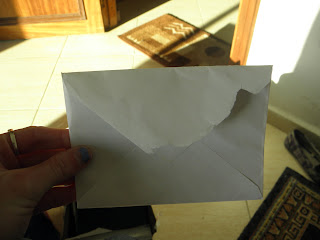

It looks like it survived a war though...


I was still very excited to get this package. I have been waiting for mail for soo long. And since sunscreen is apparently not something you can buy here, I desperately needed this. My pale skin does not handle this African sun very well.

So i knew the government here was very controlling, but I guess it never really hit home until this package came. I've seen the police stop cars for no reason, I've heard about the informants(regular people who sell every detail about their neighbors' lives to the government), but i still didn't fully understand. Now I do.
Not only was the package already opened, I had expected that much atleast, but the envelope with the card from my mom was opened. Someone ripped open the envelope and read my letter. It's not even a really personal letter, but I still feel slightly violated. These are the things that really make me appreciate the US.


Tuesday, March 1, 2011
Drinking the Nescafe
If you are my friend on facebook, you will see that I have a slight addiction to news articles from Al Jazeera English, yahoo news, and other sources. I read a lot of articles and I post the ones that I feel the need to spread. I have mentioned earlier that I will be doing a post about the revolutionary trend in the Middle East right now. Before I do this post though, I would like to get your thoughts and questions about the matter. I could easily write my opinion about the whole thing, but this is supposed to be mainly about the facts. So I'm putting the questions to you, what do you want to know? What would you like explained? Send it in an email, or leave a comment. I will then do my best to talk to local Moroccans, find related news articles, and then also offer my own opinion. Hopefully, at the end, I will have one comprehensive post that helps with understanding the situation in the Middle East and specifically in Morocco.
:)
:)
Saturday, February 26, 2011
Travels Within Morocco: Chefchaouan

Last weekend, after the Prophet’s Birthday, a small group of us went to the city of Chefchaouan, also known as the Blue City. It was absolutely amazing. This city is set in the valley of the Rif Mountains so it is completely surrounded by gorgeous landscapes. It is called the Blue City because many of the walls and buildings in the medina are painted this brilliant shade of blue. For more information on the history of the city itself visit Tiffany’s blog here:Tiffany's Blog. I am going to focus on the travel aspect of our adventure because traveling within Morocco is not always easy and other people may want to learn from our mistakes.


There is no direct train or bus to get from Meknes to Chefchaouan. You can take the train to Fez and then a bus to Chefchaouan, but that requires knowing the bus schedule before you get to Fez. In the US, something like that would probably be posted online, but we’re in Africa. We’re lucky they had a website at all. So to get there, we ended up taking a Grand Taxi. It cost 1,000 Dirhams to take the 4 hours taxi ride to Chefchaouan whether we had 2 people in the taxi or 6. We ended up having 4 people, which worked out well because even though they say there’s room for 6 there’s really only room for 4. This worked out to 250 Dirhams per person, a little expensive by Moroccan standards (roughly $32) but still not bad.


Laura, the ISA director, warned us that when we get out of the taxi we will be bombarded by people offering us “help.” They will say “Oh, my cousin has a hotel, let me show you the way!” or “My brother’s restaurant, it’s very good, very cheap, I will take you.” Then they expect you to pay them for walking you to where ever. You have to be very forceful with these people when you tell them no or else they will follow you and keep asking. Don, another ISA student, was the only boy with us, which worked out well for us girls, but maybe not so well for him. Most of the people would defer to him to answer their questions and offer him help since he was the man and obviously in charge. After about 10 minutes though, we finally made our point and were left alone.


We briefly stopped for lunch and then made our way to the hotel so we could ditch our bags and look a little less like tourists. Although, when you’re a group of white kids, people just kind of assume. They assume that you are a tourist and that you have money.


We borrowed two guide books from the ISA office, Frommers and Lonely Planet, which were very helpful in finding the right hotel and giving us ideas for what to do in the area. We ended up staying in Hotel Marrakech and I highly recommend it. None of the hotels in Morocco are up to American/Western standards. You kind of have to lower your expectations a bit when traveling in Morocco. So when I say that it was a good hotel, I mean that it had a normal toilet and friendly staff. The main draw to this hotel was that it was decorated to match the city. So everything was blue! The bed covers, the curtains, the walls; all were bright blue. It was very peaceful and relaxing. The guy who runs the hotel was very nice and very understanding of our language barriers. The hotel offers many different room options, the cheapest for us worked out to be one room with one double bed and one twin bed for the three of us girls and one room with one double bed for Don, a total of 508 Dirhams. All four of us split the cost so that it was equal for everyone, 127 Dirhams each(roughly $16 for one night). This came with breakfast, our own bathroom (which does not come standard in all hotels or even all of the rooms in this hotel) and hot water. Our bathroom did have a shower, but it was a little strange. And by a little, I mean a lot. It had seven different shower heads, all at different heights, and when you turned the knob, they all turned on spurting water everywhere. This would be somewhat ok if the shower had its own space, but it doesn’t. It is just on the wall, in between the sink and the toilet, with a drain in the middle of the room. So to take a shower you more or less have to sit on the toilet. We all just decided to skip showering that night because we didn’t want to flood the bathroom.


Something else to note about Chefchauan, it is the marijuana capital of Morocco. This was something we found out about two hours into our taxi ride by reading the guide books. The Rif Mountain area has a huge cannabis farm industry that supplies most of Europe with its pot. This is where the word reefer comes from, the Rif valley. One of the guide books mentions that anyone who looks “slightly alternative” will be offered hashish and/or marijuana. We turned this into our catch phrase for the weekend, constantly deciding who and what was slightly alternative and who was not. We were offered quite a few times, possibly because “slightly alternative” means young white tourist, and even though we found the offers very humorous (you like some good marijuana???) we declined. The town definitely has a large hippy culture, so if that’s your thing definitely make a stop. But keep in mind that they are generally the same everywhere. You won’t really be getting a taste of Moroccan culture by staying in the hippy areas of Chefchaouan.


The rest of the time in Chefchaouan went pretty smoothly. We found good places to eat, met some very nice people, hiked up a mountain trail, and shopped in the medina. Oh and took lots and lots of pictures (I took about 180 which I thought was a lot until Tiffany told me she had close to 400). It wasn’t until it was time to go home that we ran into travel problems.


You may or may not have heard about the protests in Morocco. They aren’t very big, very violent, or very revolutionary so the media hasn’t really been paying attention. But they still impacted the country. Protests were scheduled for Sunday Feb. 20th ; the day that we had planned to be traveling back to Meknes. Our plan was to take the bus to Fez, and from Fez we would take the train to Meknes. The bus ride was fine, longer than expected but still fine. We got off the bus in Fez and immediately things go awry. We are approached by two men, who say they work for the bus station, and want to help us get a taxi. We don’t believe them because a. they are not wearing uniforms(although now that I think about it, unless you are the police no one here as uniforms) and b. we were approached by a lot of people in Chefchaouan who wanted to “help.” Turns out these guys were legit though. Because of the protests the trains were not running so we couldn’t get on the train to Meknes. We were also informed that there were lots of people in the streets and as foreigners it would even be dangerous to try to get to the train station. So we were pretty much stuck with whatever help these guys could give us. One of the men, who spoke pretty good English, went outside and organized a taxi ride to Meknes for us. The taxi driver didn’t speak any English so in the end I’m glad this man helped us. We paid a total of 500 Dirhams for the ride 45 minute ride to Meknes. Anyways, lesson learned, do not make travel plans on a national day of protest.


This taxi ride provides the perfect opportunity to introduce you all to certain aspects of Moroccan life; constant government control and bribing the police. All along the highway and any intercity roads there are police stationed. Any one of them can decide at any point in time to make you pull over. They can have any reason at all. Maybe you are a guy and you are driving a female friend home, they will pull you over and ask why you have a woman in your car. I was surprised that our taxi on the way to Chefchaouan made it the entire way without getting stopped. We weren’t so lucky on the way back. Taxis and buses all have different types of licenses that authorize where they are allowed to drive. It turns out that our taxi driver was only authorized to drive in Fez, so we got pulled over as we neared Meknes. They asked him what he was doing, why he was in Meknes, even though they knew he was a taxi driver and that he was probably taking customers to where they needed to go. The police demanded money to let him continue. Our driver paid them 20 Dirhams and was allowed to continue on his way. Bribing the police is so normal that the police expect it. This happens to be one of the things that people were protesting. Government corruption is so bad that it has trickled down all the way to the traffic cops. I can’t even imagine offering a bribe to a police officer in the US let alone having them expect it of me.


The driver, after paying the police, got in the car and started to explain the situation to us. It was at this point that he discovered I could speak a little bit of Arabic. After that he talked to me for a bit, complimented my limited Arabic skills, and asked about our stay in Meknes. Finally after 4 hours of bus ride and 45 minutes of taxi we had made it back to Meknes. We were all so exhausted, all we wanted to do was get home, check our email, and go to bed. Too bad we found out we had no internet as soon as we got there.
It hasn’t been too bad without the internet though. Tiffany and I have both realized how dependent we are on the internet and that it might be good for us to not have unlimited access. We’ve been going to the Marilyn Café which has free wifi and to the ISA office to use the internet. It gets us out of the house for a bit and prevents us from constantly being online.
I know many of you are interested in the crazy revolution trend that is sweeping the Middle East and North Africa. I will be writing about this soon, I just need to work out exactly what I’m going to say. Just to put minds at ease, the situation in Morocco is nowhere near as chaotic, dangerous, or revolutionary as that in Tunisia, Egypt, Bahrain, Yemen, and Libya. The people of Morocco generally like their king and his rule, but they want to make some changes, some constitutional amendments. This is vastly different than wanting to throw out the entire government altogether. Moroccans enjoy a large number of freedoms that the people in those countries do not. The Moroccan government even approved the protests saying that it supports the people’s right to protest peacefully and to voice their opinions.


Subscribe to:
Posts (Atom)